wisemonkeys logo
FeedNotificationProfileManage Forms
FeedNotificationSearchSign in
wisemonkeys logo

Blogs

Building a Simple Doctor Appointment System in Common Lisp

profile
Shubham Giri
Jul 16, 2025
0 Likes
0 Discussions
0 Reads

🧠 Introduction

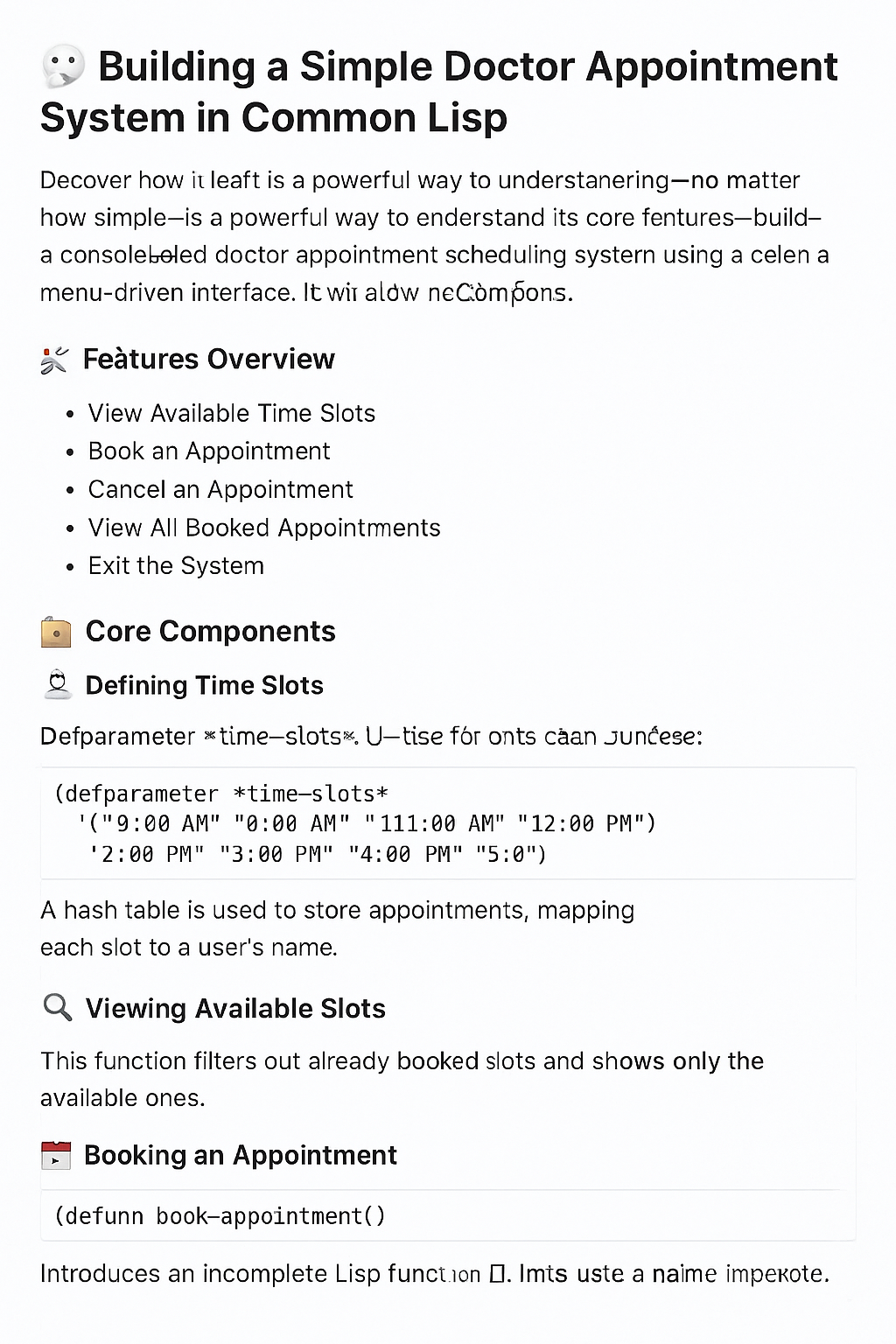
When learning a new language, building real-world applications—no matter how simple—is a powerful way to understand its core features. In this post, we will implement a console-based doctor appointment scheduling system in Common Lisp. It will allow users to book, cancel, and view appointments using a clean menu-driven interface.


🛠️ Features Overview

View Available Time Slots


Book an Appointment


Cancel an Appointment


View All Booked Appointments


Exit the System


📦 The Core Components

Let’s walk through how each part of the code contributes to the functionality:


1. 📅 Defining Time Slots


(defparameter *time-slots*

'("9:00 AM" "10:00 AM" "11:00 AM" "12:00 PM"

"2:00 PM" "3:00 PM" "4:00 PM" "5:00 PM"))

These are our fixed time slots. The user can choose from these to book an appointment.


2. 📂 Creating the Appointments Table


(defparameter *appointments* (make-hash-table :test 'equal))

A hash table is used to store appointments, mapping each slot to a user's name.


3. 🔍 Viewing Available Slots


(defun view-available-slots ()

(format t "~%Available Slots:~%")

(dolist (slot *time-slots*)

(unless (gethash slot *appointments*)

(format t "~A~%" slot))))

This function filters out already booked slots and shows only the available ones.


4. 📥 Booking an Appointment


(defun book-appointment ()

;; code continues...

)

The user enters their name and picks a slot. The function validates the input and checks availability before booking.


5. ❌ Cancelling an Appointment


(defun cancel-appointment ()

;; code continues...

)

Users can cancel their appointments by providing their name. It searches the hash table and removes matching entries.


6. 📋 Viewing All Appointments


(defun view-appointments ()

;; code continues...

)

Prints a list of all booked slots along with the names of users who booked them.


7. 📱 User Interface - The Main Menu

(defun main-menu ()

;; loop with case options

)

A looping text interface that allows the user to interact with the system repeatedly until they choose to exit.





Comments ()


Sign in

Read Next

Jira Software

Blog banner

What are NFT s?

Blog banner

IoT Architecture Based Security

Blog banner

Service design process in ITSM

Blog banner

Deadlock

Blog banner

Memory Management

Blog banner

Use case of K-means clustering

Blog banner

Deadlocks in Operating Systems

Blog banner

The Importance of Financial Literacy for College Students

Blog banner

Big Data

Blog banner

Twisted world

Blog banner

Memory Management

Blog banner

Deadlock and Starvation

Blog banner

ARTICLE ON WRIKE CORPORATION

Blog banner

Modern Operating System

Blog banner

Windows Operating System

Blog banner

Outlook mail

Blog banner

Memory management

Blog banner

Deadlock and starvation

Blog banner

Real Time Scheduling

Blog banner

Review on Cyber Forensics and its Analysis Tools

Blog banner

Modern Operating Systems

Blog banner

Big Data Architecture

Blog banner

DEVELOPMENTS LEADING TO MODERN OPERATING SYSTEMS

Blog banner

ARTICAL ON MANAGEMENT SYSTEM

Blog banner

FAMILY WHERE LIFE BEGINS....

Blog banner

Memory Management

Blog banner

Steps to create an Ubuntu EC2 Instance with GUI in AWS

Blog banner

Retiring ISS

Blog banner

VIRTUAL MACHINES

Blog banner

Explaining Buffer Overflow with Example

Blog banner

Navigation With Indian Constellation(NavIC) by ISRO in Geographic Information Systems

Blog banner

5 Common Faults In Construction Tenders

Blog banner

Mutual exclusion

Blog banner

Hypothesis Testing in Data Science

Blog banner

OS ASSIGNMENT

Blog banner

Harsh Rathod

Blog banner

Sage business cloud accounting

Blog banner

What are the different types of E-mail crime and process of email forensic?

Blog banner

Types Of Interrupt

Blog banner

Understanding Mobile Device Forensics

Blog banner

DURGA POOJA

Blog banner