wisemonkeys logo
FeedNotificationProfileManage Forms
FeedNotificationSearchSign in
wisemonkeys logo

Blogs

A-B-C of Networking: Part-2 (Components)

profile
Chayan Bhattacharjee
Mar 26, 2017
0 Likes
0 Discussions
680 Reads

'B' of "Networking"

"A-B-C of Networking: Part-1" dealt with the 'A' of "Networking" i.e the concept of networking. Next we move on to "B" which is the *COMPONENT of networking. Components of networking are SENDER, MESSAGE, MEDIUM, PROTOCOL, RECEIVER.
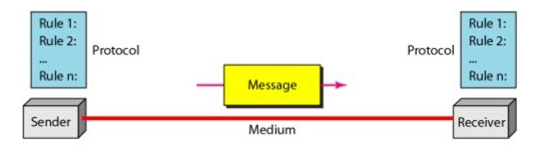


5 components of Networking

Source: Data Communication, Kwangwoon University


I. SENDER (often referred to as 'transmitter') is the party that sends the message.

II. RECEIVER is the party that receives the message.

III. MESSAGE is any data that is been transmitted from sender to receiver.

IV. {MEDIUM, PROTOCOL} often not considered as single entity but it can be because each of them has a relation. The medium (2 types: wired & wireless (will be discussed later in depth)) is the channel that is used and protocol is the set of rules that are defined for that medium. For example, BLUETOOTH falls under the category of wireless MEDIUM but it implements the PROTOCOL of IEEE 802.15. Thus answering HOW the network is functioning.


These 5 components when placed together to form a network, it becomes important to checkout their arrangements and positioning in the network. In technical terms, the schematic representation of the network must also be taken into consideration and this schematic representation, in networking terms is called as TOPOLOGY of the network (topology description in "A-B-C of Networking: Part-3").


*Component: it implies to the entities or the participants involved in the exchange of data


Comments ()


Sign in

Read Next

Evolution of operating system

Blog banner

Understanding E-mail Servers

Blog banner

E-BUSINESS RISK MANAGEMENT

Blog banner

Child labour

Blog banner

Image Steganography: Hiding Secrets in Plain Sight

Blog banner

Why Time Management Is the Secret to College Success (and How to Master It)

Blog banner

1.1 basic elements

Blog banner

City of Mumbai (Bombay):

Blog banner

Advanced Persistent Threats (APTs)

Blog banner

DNS Cache

Blog banner

COMMUNICATION

Blog banner

New Ransomware Encrypts Your Android And Then Changes PIN Lock

Blog banner

Threat management

Blog banner

What is a Malware ?

Blog banner

Quality check in IT services

Blog banner

Whatsapp Messenger

Blog banner

Service Validation and Testing during the Design Phase

Blog banner

Operating system and overviews

Blog banner

MODERN OPERATING SYSTEMS

Blog banner

Buffering

Blog banner

Direct Memory Access

Blog banner

"Geographic Information Systems (GIS) and its Applications in Urban Planning"

Blog banner

Exploring Virtual Machines and Computer Forensic Validation Tools

Blog banner

Study of Sniffing Tools

Blog banner

Different types of e-commerce platforms or advantages and disadvantages

Blog banner

Beautiful and stunning natural phenomena worth to see

Blog banner

Deadlocks in Operating Systems

Blog banner

Socket Programming in Java

Blog banner

Cache memory

Blog banner

Linux -V Server Virtual Machine

Blog banner

Multiprocessor scheduling

Blog banner

WAKE UP ITS FOOD o'CLOCK...!!!!!

Blog banner

Broken Authentication Attacks

Blog banner

IO Buffers

Blog banner

SEIZING DIGITL EVIDENCE AT THE SCENE

Blog banner

Virtual Memory

Blog banner

An Approach To Spyware Detection And Removal

Blog banner

security requirements for safe e-payment

Blog banner

Virtual Machine

Blog banner

Earth with no trees

Blog banner

Demystifying Cryptography: A Beginner's Guide

Blog banner

SECURITY TOOLS

Blog banner