wisemonkeys logo
FeedNotificationProfileManage Forms
FeedNotificationSearchSign in
wisemonkeys logo

Blogs

Deadlocks in Operating Systems

profile
Mansi Barot
Aug 15, 2024
0 Likes
0 Discussions
145 Reads

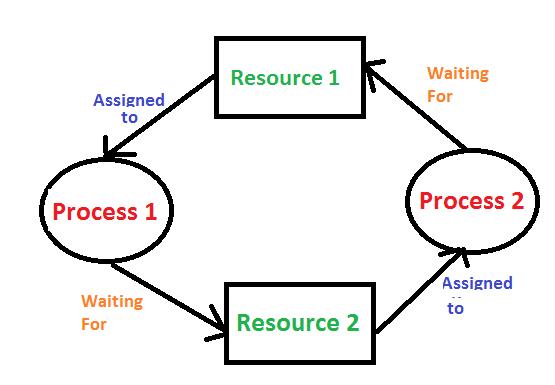
In an operating system, a deadlock occurs when a set of processes get stuck because each process is waiting for a resource that another process in the set is holding. None of the processes can proceed because they are all waiting for resources that are currently being held by each other, creating a cycle of dependency.


  • Conditions for Deadlock: A deadlock happens when all of these four conditions occur simultaneously:
  1. Mutual Exclusion: At least one resource must be held in a non-shareable mode (i.e., only one process can use the resource at a time).
  2. Hold and Wait: Processes holding resources can request new ones without releasing what they already have.
  3. No Preemption: Resources cannot be forcibly taken away from a process; they must be released voluntarily.
  4. Circular Wait: A circular chain of processes exists where each process is waiting for a resource held by the next process in the chain.


  • Dealing with Deadlocks

Operating systems use various strategies to handle deadlocks:

  • Deadlock Prevention: Modify the system to prevent one of the four conditions from occurring.
  • Deadlock Avoidance: Use algorithms like Banker's Algorithm to avoid unsafe states.
  • Deadlock Detection and Recovery: Allow deadlocks to happen, but detect and resolve them by terminating or preempting processes.
  • Ignoring Deadlock: In some systems (e.g., UNIX), deadlocks are ignored under the assumption that they are rare.


In an easier way to understand, imagine you're playing a game with your friends, and you all want to use each other's toys at the same time. But no one is willing to share until they get the toy they want. Now, everyone is stuck waiting, and no one can keep playing. 

In an operating system, a deadlock is like that. It's when programs are waiting for resources (like memory or files) that another program is using. But since each program is waiting and won't give up what it already has, they all get stuck and can't continue.


Comments ()


Sign in

Read Next

PROCESS STATES OF OPERATING SYSTEM

Blog banner

The Essential Guide to Dynamic Arrays vs. Linked Lists: Which to Use and When ?

Blog banner

Capacity management in ITSM

Blog banner

Embedded Operating System

Blog banner

An Overivew Of Cache Memory

Blog banner

Virtual Machine

Blog banner

A Deep Dive

Blog banner

OS Assignment 1

Blog banner

Article on Fresh Book

Blog banner

Operating System

Blog banner

Consumer to consumer Business model

Blog banner

MODERN OPERATING SYSTEM

Blog banner

Respondo Launches Revolutionary Video Discussion App

Blog banner

Multiprocessor and Multicore Organization

Blog banner

The IT Service Lifecycle

Blog banner

Evolution of Operating System

Blog banner

Uniprocessor and Types

Blog banner

VIRTUAL MACHINE

Blog banner

Flipkart

Blog banner

DURGA POOJA

Blog banner

Docker Framework

Blog banner

What is process

Blog banner

Importance of modern technology era

Blog banner

virtual machine

Blog banner

10 Unsolved Mysteries all over the world

Blog banner

History of Money

Blog banner

How to use open SSL for web server - browser communication

Blog banner

Explain DBMS in Brief

Blog banner

INTRODUCTION TO C#

Blog banner

OS assignment 3

Blog banner

'Positivity in life'

Blog banner

Shoulders

Blog banner

Direct Memory Access

Blog banner

How To Invest In Indian Stock Market @ BSE & NSE ~ Tutorial 3

Blog banner

RAID

Blog banner

IoT Architecture Based Security

Blog banner

10 Amazing facts about Tokyo Ghoul

Blog banner

Navigating the Digital Battlefield: Security Breaches and Effective Countermeasures

Blog banner

Fashion design

Blog banner

Service Operations Principles

Blog banner

1.1 basic elements

Blog banner

Solitary Play Activities for Preschoolers: Types and Benefits

Blog banner