The complete lifecycle of a Predictive modeling includes Data Cleaning, Pre-processing and Data Wrangling. Now comes the stage where we try to fit in the model and the end goal is to achieve Low Bias and Low Variance. The most important step is of Model Evaluation post Model Creation . We often fail to understand the resultant performance Evaluation metrics.
Let us know go through the Confusion Matrix-
Supervised Classification problems are evaluated with the help of Confusion Matrix.
Today, let’s understand the confusion matrix once and for all.
It is a table of 2x2 having combinations of actual and predicted values.
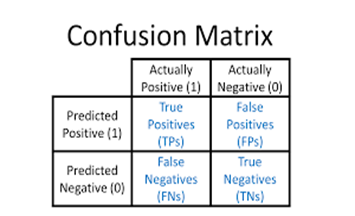
It is also useful for evaluating other performance values such as Precision, Recall, Accuracy.
Let’s understand this in simple Terms-
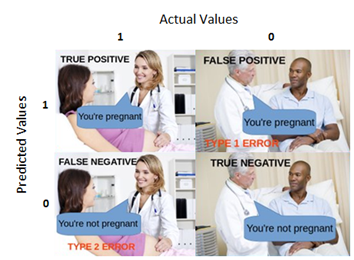
True Positive(TP) — You predicted a woman is pregnant and she is pregnant in reality
True Negative(TN)- You predicted a man is not pregnant and he is actually not.
False Positive(FP)- You predicted a man is pregnant but he is not in reality. It is also called as Type I error.
False Negative(FN)- You predicted a woman is not pregnant but she is pregnant in reality. It is also called as Type II error.
Recall- It is also called as Sensitivity and True Positive Rate.
Recall(TPR)= TP/(TP+FN)
It states, out of all positive how much our model is able to correct direct.
We should focus on increasing Recall when False Negative is very important to us. For example,
A person has cancer and we have predicted that he does not have cancer.
Precision- It is also called as Positive Pred Value and False Positive Rate. It is the Type I error in our confusion matrix.
Precision(FPR) = TP/(TP+FP)
It states, out of all the positive predicted classes how many are actually positive.
We often focus on increasing Precision when False Positive is of higher importance. For example, A mail is not spam but we have predicted it as Spam.
Accuracy- It is the matrix of our correctly predicted values by all the values of the matrix.
Accuracy= TP+TN/(TP+FP+FN+TN)
I hope I’ve given you some basic understanding on what exactly is confusing matrix. If you like this post, please clap👏 to motivate .
Let’s connect on :
Likedln : https://www.linkedin.com/in/prerna-nichani
Thankyou for Reading!