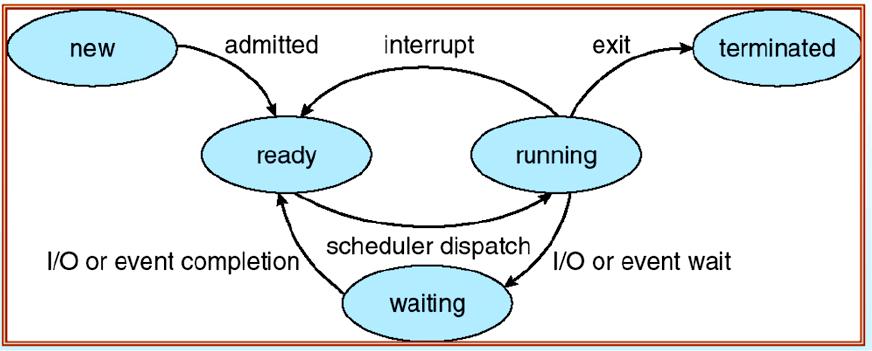
A process is just an instance of an executing program, including the current values of the program counter, registers, and variables
In any multiprogramming system, the CPU switches from process to process quickly,running each for tens or hundreds of milliseconds
Process Creation:
• Four principal events cause processes to be created:
1. System initialization.
2. Execution of a process-creation system call by a running process.
3. A user request to create a new process.
4. Initiation of a batch job.
• When an operating system is booted, typically numerous processes are created. Some of these are foreground processes, that is, processes that interact with (human) users and perform work for them.
• For example, one background process may be designed to accept incoming email,sleeping most of the day but suddenly springing to life when email arrives. Another background process may be designed to accept incoming requests for Web pages hosted on that machine, waking up when a request arrives to service the request.
• In addition to the processes created at boot time, new processes can be created afterward as well. Creating new processes is particularly useful when the work to be done can easily be formulated in terms of several related, but otherwise independent interacting processes.
• For example, if a large amount of data is being fetched over a network for subsequent processing, it may be convenient to create one process to fetch the data and put them in a shared buffer while a second process removes the data items and processes them. On a multiprocessor, allowing each process to run on a different CPU may also make the job go faster
Process Termination:
• After a process has been created, it starts running and does whatever its job is.
• However, nothing lasts forever, not even processes.
• Sooner or later the new process will terminate, usually due to one of the following
conditions:
1. Normal exit (voluntary).
2. Error exit (voluntary).
3. Fatal error (involuntary).
4. Killed by another process (involuntary).
• Most processes terminate because they hav e done their work. When a compiler has compiled the program given to it, the compiler executes a system call to tell the operating system that it is finished. This call is exit in UNIX and ExitProcess in Windows.
• The second reason for termination is that the process discovers a fatal error.
• The third reason for termination is an error caused by the process, often due to a program bug. Examples include executing an illegal instruction, referencing nonexistent memory, or dividing by zero. In some systems (e.g., UNIX), a process can tell the operating system that it wishes to handle certain errors itself, in which case the process is signaled (interrupted) instead of terminated when one of the errors occurs.
• The fourth reason a process might terminate is that the process executes a system call telling the operating system to kill some other process. In UNIX this call is kill. The corresponding Win32 function is TerminateProcess.