Supervised And Unsupervised Learning
Machine learning is a sub field of artificial intelligence (AI) that provides systems the ability to automatically learn and improve from experience without being explicitly programmed. With Machine Learning, users input large amounts of data into an algorithm, which enables the computer to make recommendations and decisions based on that data.
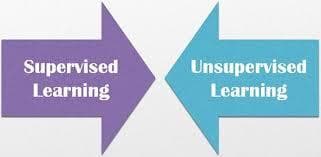
Machine learning algorithms are usually categorized as Supervised or Unsupervised.
Supervised Learning
In supervised learning, the computer is taught by example. It learns from past data and applies the learning to present data to predict future events. In this case, both input and desired output data provide help to the prediction of future events.
For accurate predictions, the input data is labeled or tagged as the right answer.
The research needs to have at hand a dataset with some observations and the labels/classes of the observations. For example, the observations could be images of animals and the labels the name of the animal (e.g. cat, dog etc).
These models learn from the labeled dataset and then are used to predict future events. For the training procedure, the input is a known training data set with its corresponding labels, and the learning algorithm produces an inferred function to finally make predictions about some new unseen observations that one can give to the model. The model is able to provide targets for any new input after sufficient training. The learning algorithm can also compare its output with the correct intended output and find errors in order to modify itself accordingly (e.g. via back-propagation).
Supervised models can be further grouped into regression and classification cases:
Classification Models – Classification models are used for problems where the output variable can be categorized, such as “Yes” or “No”, or “Pass” or “Fail.” Classification Models are used to predict the category of the data. Real-life examples include spam detection, sentiment analysis, scorecard prediction of exams, etc.
Regression Models – Regression models are used for problems where the output variable is a real value such as a unique number, dollars, salary, weight or pressure, for example. It is most often used to predict numerical values based on previous data observations. Some of the more familiar regression algorithms include linear regression, logistic regression, polynomial regression, and ridge regression.
There are some very practical applications of supervised learning algorithms in real life, including:
Unsupervised Learning
Unsupervised learning, on the other hand, is the method that trains machines to use data that is neither classified nor labeled. It means no training data can be provided and the machine is made to learn by itself. The machine must be able to classify the data without any prior information about the data.
The idea is to expose the machines to large volumes of varying data and allow it to learn from that data to provide insights that were previously unknown and to identify hidden patterns. As such, there aren’t necessarily defined outcomes from unsupervised learning algorithms. Rather, it determines what is different or interesting from the given dataset.
The machine needs to be programmed to learn by itself. The computer needs to understand and provide insights from both structured and unstructured data.
The research needs to have at hand a dataset with some observations without the need of having also the labels/classes of the observations. Unsupervised learning studies how systems can infer a function to describe a hidden structure from unlabeled data. The system doesn’t predict the right output, but instead, it explores the data and can draw inferences from datasets to describe hidden structures from unlabeled data.
Unsupervised models can be further grouped into clustering,association and Dimensionality reduction
Clustering is a data mining technique for grouping unlabeled data based on their similarities or differences. For example, K-means clustering algorithms assign similar data points into groups, where the K value represents the size of the grouping and granularity. This technique is helpful for market segmentation, image compression, etc.
Association is another type of unsupervised learning method that uses different rules to find relationships between variables in a given dataset. These methods are frequently used for market basket analysis and recommendation engines, along the lines of “Customers Who Bought This Item Also Bought” recommendations.
Dimensionality reduction is a learning technique used when the number of features (or dimensions) in a given dataset is too high. It reduces the number of data inputs to a manageable size while also preserving the data integrity. Often, this technique is used in the preprocessing data stage, such as when autoencoders remove noise
Applications of Unsupervised Learning Algorithms
Some practical applications of unsupervised learning algorithms include: