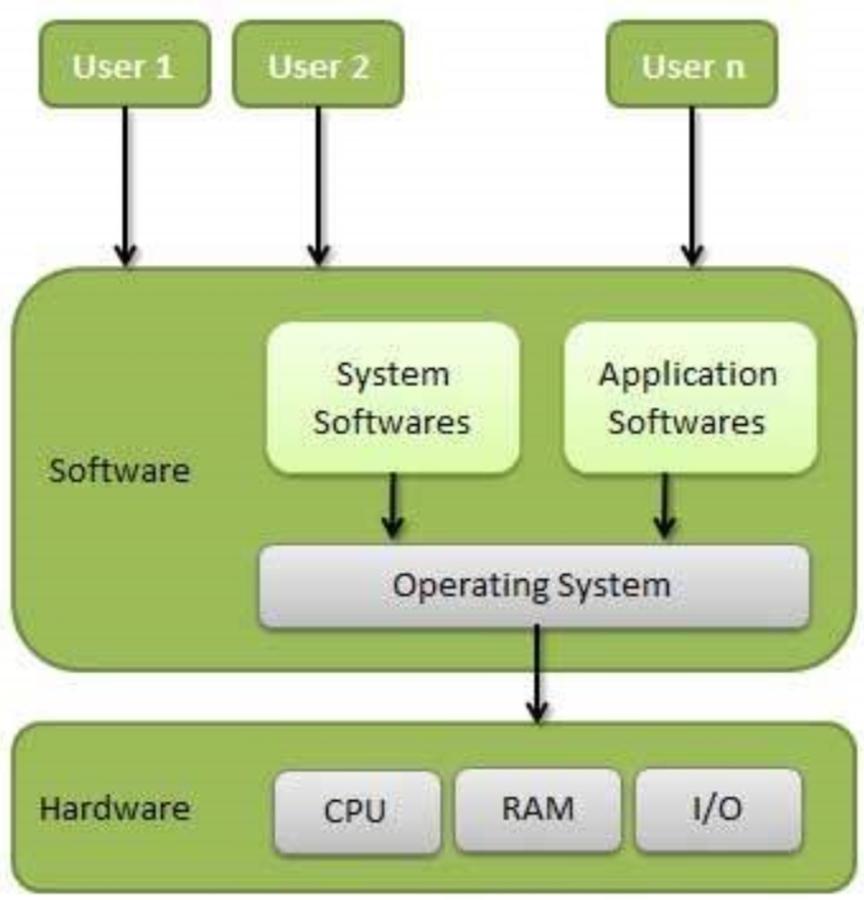
An operating system (OS) is a type of system software that controls the hardware and software resources of a computer and offers standard functions to software applications.
An operating system's job is to create an environment where users may run programmes conveniently and effectively. Users (those who use the computer) make up a computer system.
Applications (such as compilers, databases, video players, games, and browsers) System programmes, such as compilers, editors, and shells Operating System: (A unique programme that serves as a conduit between the hardware and the user) Hardware: CPU, drives, memory, and so forth
We require a system that can manage all of the system's resources and processes while serving as an intermediate.
In addition to scheduling tasks for optimal system utilisation, time-sharing operating systems may have accounting software for the cost allocation of peripherals, mass storage, CPU time, and other resources. Software development on computers benefits greatly from an operating system.
Without an operating system, each programme would have to have both the user interface (UI) and the extensive code required to manage all of the computer's low-level features, like network ports and disc storage. This will drastically bloat the size of any application and render software development unfeasible given the wide variety of underlying hardware that is already accessible.
Rather, a lot of routine jobs, like transmitting a packet over the network or putting text on a display or other common output device, can be delegated to system software, which acts as a bridge between the hardware and applications.
Applications don't need to know any specifics about the hardware to interact with it in a consistent and repeatable manner thanks to the system software. The operating system, which is system software, may support nearly any number of applications as long as they all use the same resources and services and do so in an identical manner.
This ensures that users may control, configure, and manage the system hardware through a well-understood and standard interface, saving a significant amount of time and coding needed to design and debug an application.
The operating system serves as a bridge between programmes and computer hardware for hardware functions like input and output and memory allocation, even though the application code is typically executed directly by the hardware and frequently calls an OS function or is interrupted by it. Operating systems are present in a wide range of computing devices, including web servers, supercomputers, mobile phones, and game consoles.
The five most widely used operating systems are Apple macOS, Microsoft Windows, Linux, Android OS from Google, and Apple iOS.
While some operating systems can operate straight off media (like a live CD) or flash memory (like a USB stick), others need to be installed or may come pre-installed with computers that are purchased (OEM-installation).
NAME:-Kasak Mehta
SAP ID:-53003230071