wisemonkeys logo
FeedNotificationProfileManage Forms
FeedNotificationSearchSign in
wisemonkeys logo

Blogs

Deadlock and Starvation

profile
Khush Bagaria
Aug 15, 2024
0 Likes
0 Discussions
119 Reads

1. Deadlock


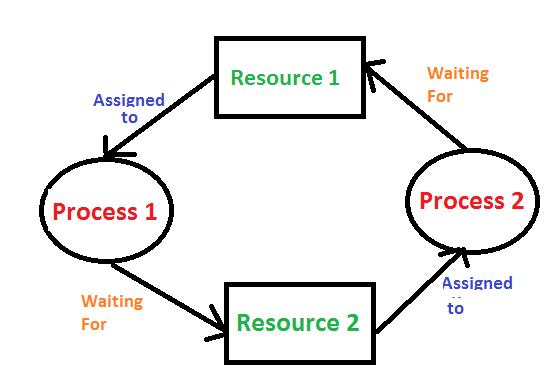
Deadlock in an operating system occurs when a set of processes become stuck because each process is waiting for a resource that another process holds, and none of the processes can proceed. This situation usually arises in multi-process systems where processes share resources such as files, memory, or devices. The four necessary conditions for deadlock, often referred to as Coffman’s conditions, are mutual exclusion, hold and wait, no preemption, and circular wait. If all these conditions hold simultaneously, the system can enter a deadlock state. Deadlocks can be addressed through prevention, avoidance, or detection and recovery methods. Prevention involves designing the system to negate one or more of the Coffman conditions, while avoidance uses algorithms like Banker’s Algorithm to ensure the system never enters an unsafe state. Detection and recovery involve allowing the deadlock to occur but having mechanisms to identify and resolve it by terminating processes or rolling them back.


2.Starvation


Starvation occurs in an operating system when a process waits indefinitely to gain access to a resource it needs, even though the resource is available at times. This typically happens in scheduling algorithms that favor certain processes over others, like when a low-priority process is continually preempted by higher-priority processes. Starvation is a significant problem because it can lead to reduced system performance and inefficiency. Solutions to starvation include using aging, a technique where the priority of a waiting process is gradually increased, ensuring that every process eventually gets a chance to execute. By incorporating aging into scheduling algorithms, the operating system can prevent starvation by ensuring that processes waiting for resources for a long time are eventually given access, thus maintaining system fairness.



Comments ()


Sign in

Read Next

Service design process in ITSM

Blog banner

Functions Of Operating Systems

Blog banner

Service transistion under difficult conditions

Blog banner

Sagar Parikrama

Blog banner

Malware

Blog banner

What is the point of living if we can die at any moment of our lives ?

Blog banner

Different types of scam frauds

Blog banner

Principles of Service Operation

Blog banner

Distributed Denial of Service (DDoS) attack

Blog banner

Social Network Analysis: Ek Naya Nazariya Data Science Mein

Blog banner

Child labour

Blog banner

CONCURRENCY: MUTUAL EXCLUSION AND SYNCHRONIZATION-het karia

Blog banner

Cache memory

Blog banner

Instagram

Blog banner

Music helps reduce stress

Blog banner

Critical success factors

Blog banner

Cyber Bullying - Neeta Vonkamuti

Blog banner

Types of Hackers

Blog banner

Ola

Blog banner

Service Operation

Blog banner

Importance of Network Security Risk

Blog banner

How To Secure Operating Systems ?

Blog banner

Concurrency and Deadlocks

Blog banner

GIS Mapping

Blog banner

What is a Malware ?

Blog banner

Linux Memory Management

Blog banner

Honeypot in cyber security

Blog banner

UniProcessor Scheduling

Blog banner

Disk cache

Blog banner

virtual machine

Blog banner

A Heartfelt Act of Kindness

Blog banner

How to kiss

Blog banner

Memory Management in an Operating System

Blog banner

SPAM

Blog banner

Direct memory access

Blog banner

american greatines

Blog banner

Power of words

Blog banner

How to write a cover letter

Blog banner

Kernel in Operating System

Blog banner

DATA SCIENCE IN BUSINESS AND MARKETING

Blog banner

Memory management

Blog banner

Virtual Memory

Blog banner