
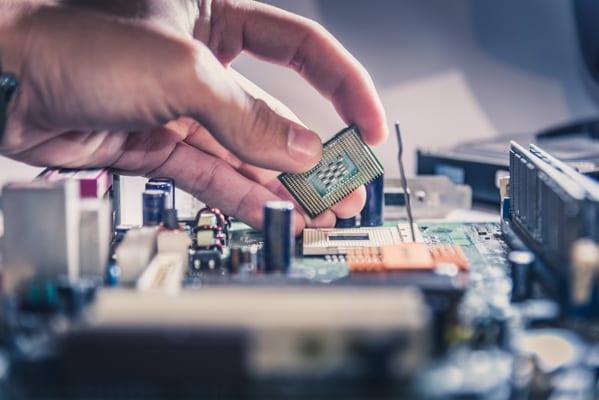
Computing has been changed forever because of the replacement of core processors by microprocessors that were smaller, cheaper, and faster. The first microprocessor, the Intel 4004, came up with the concept of Intel in 1971. These were the first embedded systems that were very different from today's. The parallelism of these early microprocessors had been much greater than expected at the beginning, but over time they had been handicapped by limitations such as clock speed, word length, hardware, and software. Nevertheless, till achieving a level where they are able to operate within sub-nanoseconds, the microprocessors have been continuous victims of the structural limitations in Semiconductor physics that bring in new, ever faster semiconductor. This rocket hike which had increased in the processor's speed makes the dynamic of the chip to rather be a function of multiple processors than solitary ones.
Each breathtaking microprocessor has an assorted amount of multi-cores and cache memories co-located inside and out to make several microprocessors the most desirable. This arrangement activates parallel processing, where every kernel can handle assignments at the same time by a further device that can support multiple hardware threads. For example, a modern laptop may carry a quad-core processor with hyper-threading, which can act as a gateway to even eight virtual processors.
This development helped Graphics Processing Units (GPUs) take care of the necessary computational tasks, first released for Graphic rendering and then used for parallel computing via SIMD techniques alone. Originally designed with real-time graphics in mind, GPUs have afterward branched out into this business, where they use a single instruction to manage various data. In addition, they have been included in industrial applications of high-performance computing, such as technology-wise simulations and machine learning which are needed to process huge amounts of data simultaneously.
More than this, the development of CPUs themselves happens through their vector units being included in them giving them the strength of being able to work through volumes of data with extraordinary energy. The eventual joining of the two is a result of intellect in architectures such as x86 and AMD64 families, which has immediately expanded the computing prospects by which applications that require heavy mathematical operations can be performed.
Another, as a qualified processor, a Digital Signal Processor (DSP) has experienced the revolution. Formerly restricted to the function of peripheral tasks such as modem operations, nowadays, DSPs are the main computational units, therefore, the streaming of live signals particular to real-time like audio and video happen at an excellent level.
Microprocessors have become more like SoCs due to the need for them to be well-suited for modern mobile gadgets and miniature. To be sure, these, which in other cases are full integration of CPU and cache and in other cases also contain GPU, DSP, and input/output devices on one chip are seen because of the SoC architecture. This fusion provides optimal performance and energy efficiency on the one hand and a wide range of tasks-from portable gaming to multimedia playback on a different hand.
Microprocessors are the poster children of the rise of constant pursuit of faster and smaller computing machines. From one piece of silicon to today's extraordinary diversity of multiprocessor Systems on Chips, these amazing processors have been the drivers of innovation in many fields and the major shapers of everyday IT experiences. As the technology race rages on, these miniaturized chips, though small in size are still loaded with enough capabilities to reshape the concept of computational and consumability.