Fault-tolerance in operating System
Fault-tolerance is the process of working of a system in a proper way in spite of the occurrence of the failures in the system. Even after performing the so many testing processes there is possibility of failure in system. Practically a system can’t be made entirely error free. hence, systems are designed in such a way that in case of error availability and failure, system does the work properly and given correct result.
Any system has two major components – Hardware and Software. Fault may occur in either of it. So there are separate techniques for fault-tolerance in both hardware and software.
Hardware Fault-tolerance Techniques:
Making a hardware fault-tolerance is simple as compared to software. Fault-tolerance techniques make the hardware work proper and give correct result even some fault occurs in the hardware part of the system. There are basically two techniques used for hardware fault-tolerance:
BIST –
BIST stands for Build in Self Test. System carries out the test of itself after a certain period of time again and again, that is BIST technique for hardware fault-tolerance. When system detects a fault, it switches out the faulty component and switches in the redundant of it. System basically reconfigure itself in case of fault occurrence.
TMR –
TMR is Triple Modular Redundancy. Three redundant copies of critical components are generated and all these three copies are run concurrently. Voting of result of all redundant copies are done and majority result is selected. It can tolerate the occurrence of a single fault at a time.

Software Fault-tolerance Techniques:
Software fault-tolerance techniques are used to make the software reliable in the condition of fault occurrence and failure. There are three techniques used in software fault-tolerance. First two techniques are common and are basically an adaptation of hardware fault-tolerance techniques.
N-version Programming –
In N-version programming, N versions of software are developed by N individuals or groups of developers. N-version programming is just like TMR in hardware fault-tolerance technique. In N-version programming, all the redundant copies are run concurrently and result obtained is different from each processing. The idea of n-version programming is basically to get the all errors during development only.

Recovery Blocks –
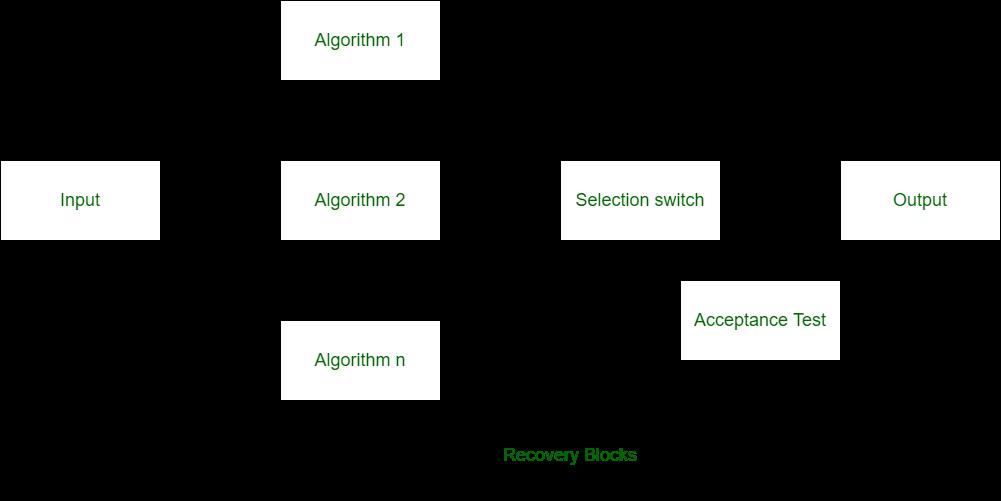
Recovery blocks technique is also like the n-version programming but in recovery blocks technique, redundant copies are generated using different algorithms only. In recovery block, all the redundant copies are not run concurrently and these copies are run one by one. Recovery block technique can only be used where the task deadlines are more than task computation time.
Check-pointing and Rollback Recovery –
This technique is different from above two techniques of software fault-tolerance. In this technique, system is tested each time when we perform some computation. This techniques is basically useful when there is processor failure or data corruption.
Nikita Mitna
Div A