
wisemonkeys logo
FeedNotificationProfileManage Forms
FeedNotificationSearchSign in
wisemonkeys logo

Blogs

All you need to know about Cassandra

profile
SANTOSH RAJBHAR
Oct 08, 2023
0 Likes
0 Discussions
143 Reads

Data Model:

  • Cassandra is a NoSQL database well-suited for handling semi-structured or unstructured data.
  • It uses a wide-column store data model, which allows for a flexible schema desig
  • Scalability:

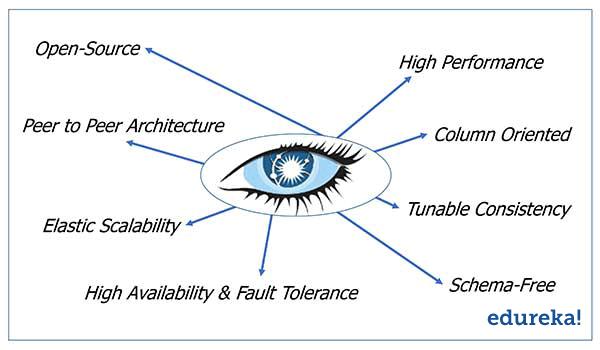
    • Cassandra is known for its horizontal scalability. It can quickly scale out by adding more nodes to a cluster to accommodate growing data volumes and user loads.
  • Performance:

    • Cassandra offers high write throughput and low-latency reads, making it suitable for applications requiring fast data ingestion and retrieval.
    • It is optimized for write-heavy workloads.
  • Consistency vs. Availability vs. Partition Tolerance (CAP):

    • Cassandra follows the CAP theorem and prioritizes both availability and partition tolerance over strong consistency.
    • It offers tunable consistency levels, allowing you to configure the level of consistency according to your application's needs.
  • Data Volume:

    • Cassandra is designed to handle large datasets efficiently, making it a good choice for applications with significant data volumes.
  • Complexity of Queries:

    • Cassandra is proficient at handling simple queries and lookups by key.
    • Complex queries may require denormalization or the use of additional tools like Apache Spark or Elasticsearch for analytics.
  • Consistency Models:

    • Cassandra supports tunable consistency, allowing you to choose the desired level of character (e.g., eventual consistency or stronger consistency) for each query.
  • Security and Compliance:

    • Cassandra provides security features like authentication, authorization, and encryption to protect your data.
    • Ensure that it meets your application's security and compliance requirements.
  • Cost and Licensing:

    • Cassandra is open source and free to use. However, there may be costs associated with infrastructure, support, and additional tools.
  • Backup and Disaster Recovery:

    • Cassandra offers features for backup and recovery to ensure data integrity and availability in case of failures.
  • Future Growth and Flexibility:

    • Cassandra's horizontal scalability and flexible data model make it suitable for applications with growth potential and changing requirements.
  • Data Integrity and ACID Transactions:

    • Cassandra provides limited support for ACID transactions and is primarily designed for eventual consistency and high availability rather than strong consistency.
  • Latency and Geographic Distribution:

    • Cassandra supports multi-datacenter replication, allowing data to be distributed across multiple geographic regions to minimize latency and improve availability.
  • Operational Complexity:

    • Managing Cassandra clusters can be complex, requiring expertise in deployment, configuration, and monitoring. Consider using managed Cassandra services or consulting services for smoother operations
  • Development Ecosystem and Support:

    • Cassandra has a well-established ecosystem with libraries, drivers, and tools available for various programming languages.
    • It benefits from a strong open-source community and vendor support from companies like DataSta
    •  

Comments ()


Sign in

Read Next

Blockchain uses and use cases

Blog banner

memory management

Blog banner

Network Forensics Tools and Techniques

Blog banner

OPERATING SYSTEM

Blog banner

E-Governance

Blog banner

Mental Health

Blog banner

The Dark Web: A Breeding Ground for Cybercriminals – How to Guard Against Threats

Blog banner

Travel: Everything Everywhere!

Blog banner

Cloud Computing

Blog banner

ARTICAL ON MANAGEMENT SYSTEM

Blog banner

Tools to support CSI activities

Blog banner

FAMILY WHERE LIFE BEGINS....

Blog banner

Types of Threads

Blog banner

Interrupts - Types, Working & Importance

Blog banner

File management

Blog banner

Evolution of Operating Systems

Blog banner

Visualization in Data Science

Blog banner

Raid

Blog banner

Memory management

Blog banner

What your Favorite colour says about You?

Blog banner

Decoding Confusion Matrix

Blog banner

Method of Evaluating Information Security Level in an Organization

Blog banner

Deadlock

Blog banner

Cyber Forensics in a Ransomware Attack Recovery

Blog banner

BLOCKCHAIN MACHANISM

Blog banner

Human Error: The weakest link in Cybersecurity

Blog banner

ADD A SPICE TO YOUR LIFE.

Blog banner

Virtual memory

Blog banner

Linux

Blog banner

Cyber Security Control

Blog banner

Risk mitigation and management

Blog banner

Electronic data interchange

Blog banner

Reclaim Your Bite and Beauty: All About Dental Restorative Treatments

Blog banner

Kernel in Operating System

Blog banner

LEMON PICKLE (NIMBU KA ACHAR)

Blog banner

Network Footprinting in Cybersecurity

Blog banner

social media issue

Blog banner

Modern Operating System

Blog banner

File management

Blog banner

Business Intelligence v/s Big Data

Blog banner

DATA WRANGLING

Blog banner

Biometric Authentication Vulnerabilities

Blog banner