
wisemonkeys logo
FeedNotificationProfileManage Forms
FeedNotificationSearchSign in
wisemonkeys logo

Blogs

Big O Notation

profile
Ronak Gala
Feb 16, 2023
1 Like
2 Discussions
169 Reads

 Big-O Analysis of Algorithms

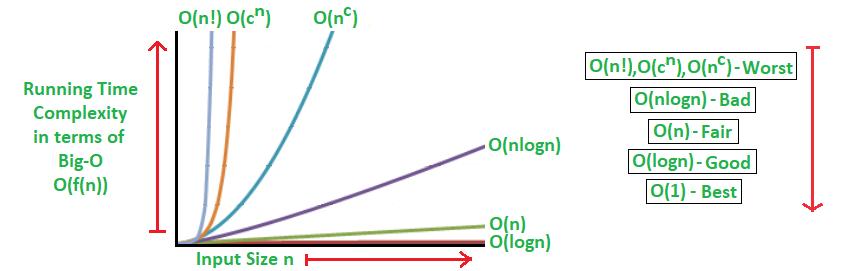
We can express algorithmic complexity using the big-O notation. For a problem of size N:

  • A constant-time function/method is “order 1” : O(1)
  • A linear-time function/method is “order N” : O(N)
  • A quadratic-time function/method is “order N squared” : O(N2 )

Definition: Let g and f be functions from the set of natural numbers to itself. The function f is said to be O(g) (read big-oh of g), if there is a constant c > 0 and a natural number n0 such that f(n) ≤ cg(n) for all n ≥ n0 .

Note: O(g) is a set!


Runtime Analysis of Algorithms

In general cases, we mainly used to measure and compare the worst-case theoretical running time complexities of algorithms for the performance analysis. 
The fastest possible running time for any algorithm is O(1), commonly referred to as Constant Running Time. In this case, the algorithm always takes the same amount of time to execute, regardless of the input size. This is the ideal runtime for an algorithm, but it’s rarely achievable. 
In actual cases, the performance (Runtime) of an algorithm depends on n, that is the size of the input or the number of operations is required for each input item. 


Comments ()


Sign in

Read Next

Kids Grieve Too

Blog banner

Deadlock

Blog banner

Privacy-Enhancing Computation Techniques

Blog banner

Flipkart

Blog banner

Mobile Transport Layer – Traditional TCP

Blog banner

Corporate Discipline.

Blog banner

Linux Memory Management

Blog banner

Outlook mail

Blog banner

SPAM

Blog banner

Child labour

Blog banner

Multicore and multithreading 171

Blog banner

Deadlock in operating system

Blog banner

Studying ProRat

Blog banner

The Laws of Karma

Blog banner

Data Science & AI

Blog banner

Quality check in IT services

Blog banner

"Geographic Information Systems (GIS) and its Applications in Urban Planning"

Blog banner

"Can Lisp do Machine Learning?"

Blog banner

Number Guessing game --lisp

Blog banner

Deadlock and Starvation

Blog banner

Linux

Blog banner

Deadlock and starvation in operating system

Blog banner

Security in Cloud Computing

Blog banner

File Management In OS

Blog banner

Harsh Rathod

Blog banner

Pink sauce pasta

Blog banner

Bharat Maps

Blog banner

Session Hijacking Techniques

Blog banner

Sage business cloud accounting

Blog banner

Memory Management

Blog banner

Meal Maharaj — 3 CP, 5 CP, 8 CP. Same Love, Different Portions

Blog banner

Music is life

Blog banner

RAID

Blog banner

Paginng In OS

Blog banner

Decoding the Weave — How to Identify Original Patola Art on a Fabric

Blog banner

Social Engineering Attacks

Blog banner

Deadlock and Starvation

Blog banner

5 People who claimed to have Time Traveled

Blog banner

Modern operating system

Blog banner

Memory management

Blog banner

Advantage of freedom

Blog banner

Social Engineering

Blog banner