wisemonkeys logo
FeedNotificationProfileManage Forms
FeedNotificationSearchSign in
wisemonkeys logo

Blogs

Cache memory

profile
Dhruv Punamiya
Jul 05, 2024
0 Likes
0 Discussions
82 Reads

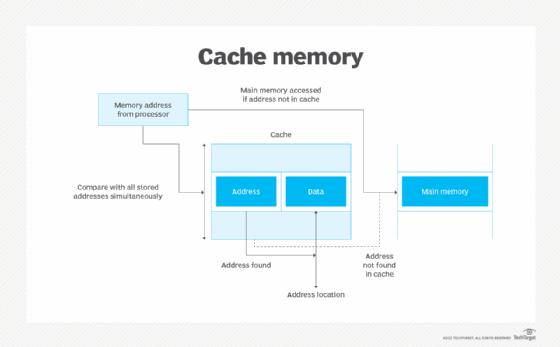
Cache memory is a small, high-speed storage located close to the CPU, designed to provide quick access to frequently used data and instructions. Acting as a bridge between the fast CPU and slower main memory, cache memory significantly boosts a computer's performance by reducing the time the CPU needs to wait for data.

There are typically three levels of cache memory: L1, L2, and L3. L1 cache is the smallest and fastest, embedded directly within the CPU chip, providing the quickest access to critical data. L2 cache is larger and slightly slower, often located on the same chip or a separate chip near the CPU. L3 cache is even larger and slower compared to L1 and L2 but is still faster than the main memory. It is usually shared among multiple CPU cores.

Cache memory operates on the principle of temporal and spatial locality. Temporal locality refers to the reuse of specific data within relatively short time intervals, while spatial locality refers to accessing data locations that are close to each other. By storing copies of frequently accessed data, cache memory minimizes the need to fetch data from the slower main memory.

The effectiveness of cache memory is measured by its hit rate, the percentage of memory accesses found in the cache. A high hit rate means the CPU spends less time waiting for data, leading to faster program execution. Modern processors employ sophisticated algorithms to manage cache content, deciding which data to keep and which to replace, ensuring optimal performance.

In summary, cache memory is a crucial component in modern computing, enhancing performance by providing rapid access to frequently used data. Its hierarchical structure, exploiting temporal and spatial locality, and advanced management algorithms make it indispensable for efficient CPU operations.



Comments ()


Sign in

Read Next

Challenges and risks in service operations

Blog banner

INTRODUCTION TO C#

Blog banner

Street foods

Blog banner

File sharing

Blog banner

What is Influencer Marketing and its Trends

Blog banner

How to feel Happy everyday day

Blog banner

Natural Language Processing(NLP)

Blog banner

Deadlock and Starvation

Blog banner

Memory hierarchy

Blog banner

HUBSPOT

Blog banner

How to kiss

Blog banner

Types of threads

Blog banner

Explain Kernel in OS

Blog banner

Synchronization

Blog banner

Deadlock and Starvation in an Operating System

Blog banner

File System

Blog banner

MEMORY MANAGEMENT

Blog banner

I/O Buffering

Blog banner

Booting Process In Operating System

Blog banner

The House ??of Patola Designs: Traditional Weaves with a Modern Twist

Blog banner

Emerging threats in cyber Forensics

Blog banner

MUTUAL EXCLUSION

Blog banner

Email Privacy

Blog banner

Number Guessing game --lisp

Blog banner

The Right way of cooking

Blog banner

Uniprocessor scheduling

Blog banner

IoT Architecture Based Security

Blog banner

ROLE OF THE COMPUTER FORENSICS TOOLS AND TECHNIQUES

Blog banner

Cyber Bullying - Neeta Vonkamuti

Blog banner

The Rise of Evil Twin Attacks: A New Kind Of Spoofing Cyberattack

Blog banner

The Memory Hierarchy

Blog banner

Bit Coins

Blog banner

EVOLUTION OF THE MIRCOPROCESSOR

Blog banner

10 Interesting Facts about Death Note

Blog banner

E-mail security

Blog banner

Improving defences Proxy Device(defense in depth)

Blog banner

10 Amazing facts about Tokyo Ghoul

Blog banner

Tomato Butter Sauce with Bucatini

Blog banner

PERSONALITY DEVELOPMENT

Blog banner

Evolution of operating systems

Blog banner

Current Trends in GIS and Remote Sensing(Ocean Applications)

Blog banner

Emailing the merger document

Blog banner