wisemonkeys logo
FeedNotificationProfileManage Forms
FeedNotificationSearchSign in
wisemonkeys logo

Blogs

Disk scheduling

profile
Raj Darji 1501
Sep 09, 2024
0 Likes
0 Discussions
84 Reads

DISK SCHEDULING

  • Disk scheduling is a technique operating systems use to manage the order in which disk I/O (input/output) requests are processed. Disk scheduling is also known as I/O Scheduling. The main goals of disk scheduling are to optimize the performance of disk operations, reduce the time it takes to access data and improve overall system efficiency.
  • In this article, we will explore the different types of disk scheduling algorithms and their functions. By understanding and implementing these algorithms, we can optimize system performance and ensure faster data retrieval.

Importance of Disk Scheduling in Operating System:

  • Multiple I/O requests may arrive by different processes and only one I/O request can be served at a time by the disk controller. Thus other I/O requests need to wait in the waiting queue and need to be scheduled.
  • Two or more requests may be far from each other so this can result in greater disk arm movement.
  • Hard drives are one of the slowest parts of the computer system and thus need to be accessed in an efficient manner.

Key Terms Associated with Disk Scheduling

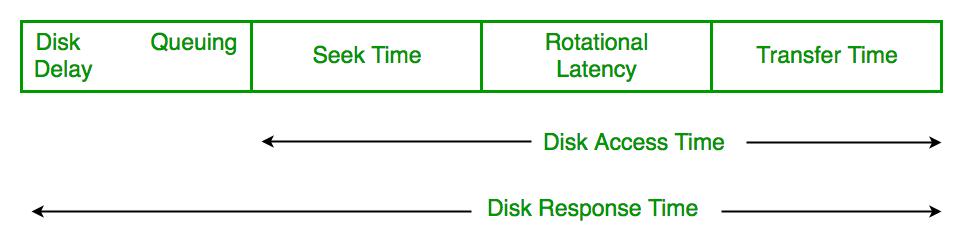
  • Seek Time: Seek time is the time taken to locate the disk arm to a specified track where the data is to be read or written. So the disk scheduling algorithm that gives a minimum average seek time is better.
  • Rotational Latency: Rotational Latency is the time taken by the desired sector of the disk to rotate into a position so that it can access the read/write heads. So the disk scheduling algorithm that gives minimum rotational latency is better.
  • Transfer Time: Transfer time is the time to transfer the data. It depends on the rotating speed of the disk and the number of bytes to be transferred.
  • Disk Access Time:
  • Disk Access Time = Seek Time + Rotational Latency + Transfer Time

Comments ()


Sign in

Read Next

Sensory Play for Toddlers: Boosting Curiosity Through Touch, Sound, and Colour

Blog banner

Big O Notation

Blog banner

Electronic data interchange

Blog banner

HTML vs HTML5

Blog banner

Fault Tolerance

Blog banner

Financial Fraud Detection

Blog banner

THE ROLE OF CYBER FORENSICS IN CRIMINOLOGY

Blog banner

Penetration Testing

Blog banner

Study on cyber and network forensic in computer security management

Blog banner

Session Hijacking

Blog banner

Internet of Things and cyber security

Blog banner

What is time ? The term which has astonished Scientists

Blog banner

Social engineering in cyber security

Blog banner

Hypothesis Testing in Data Science

Blog banner

Race condition

Blog banner

Internet of Things

Blog banner

The Bold Digital Marketing Moves That Made Durex India’s Second-Largest Condom Brand

Blog banner

EVOLUTION OF THE MIRCOPROCESSOR

Blog banner

FIREWALL

Blog banner

Short note on Microsoft office

Blog banner

Risk management in IT

Blog banner

Multiple processor scheduling

Blog banner

Elegant fashion style

Blog banner

Ransomware

Blog banner

Pilgrimage at LOC: A privilege and a paradox

Blog banner

Fault Tolerance

Blog banner

Way to make your meal healthier.

Blog banner

Threads Concurrency: Mutual Exclusion and Synchronization

Blog banner

Utilizing Data-Hiding and Retrieval Techniques in Cyber Forensics

Blog banner

OS Assignment 1

Blog banner

Should you be using a mouthwash? Know from the experts

Blog banner

Data Science in Predictive Analytics: Transforming Business Decision-Making

Blog banner

Multiprocessor and Multicore Organization

Blog banner

Embracing the power of Modern Machine UNIX

Blog banner

Synchronization

Blog banner

Inventory management software system

Blog banner

Types of Viruses

Blog banner

HOW CAN SOCIAL MEDIA MAKE YOU HAPPIER?

Blog banner

Disk scheduling

Blog banner

Introduction to Solidity Programming for Blockchain Development

Blog banner

Memory Management - operating system

Blog banner

INTERNET SECURITY

Blog banner