wisemonkeys logo
FeedNotificationProfileManage Forms
FeedNotificationSearchSign in
wisemonkeys logo

Blogs

Starvation

profile
Raj Darji 1501
Aug 14, 2024
0 Likes
0 Discussions
197 Reads

Starvation occurs when a process in the OS runs out of resources because other processes are using it. This is a problem with resource management while Operating systems employ aging as a scheduling approach to keep them from starving. It is one of the most common scheduling algorithms in batch systems. Each process is assigned a priority. The process with the highest priority is to be executed first and so on. Here we will be discussing a major problem related to priority scheduling and its solution.


What is Starvation?

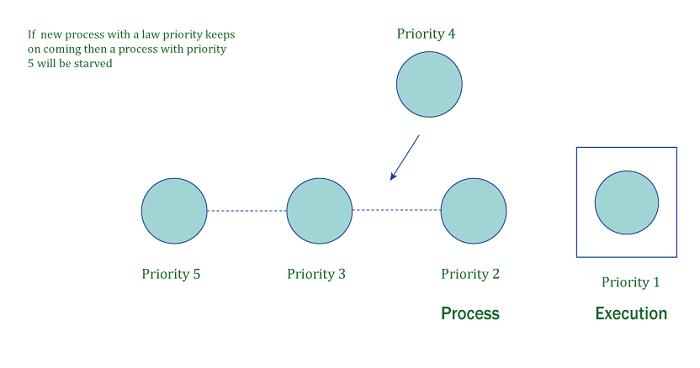
Starvation or indefinite blocking is a phenomenon associated with the Priority scheduling algorithms, in which a process ready for the CPU (resources) can wait to run indefinitely because of low priority. In a heavily loaded computer system, a steady stream of higher-priority processes can prevent a low-priority process from ever getting the CPU. There have been rumors that in 1967 Priority Scheduling was used in IBM 7094 at MIT, and they found a low-priority process that had not been submitted till 1973.


Reasons of Starvation:

  • There are not enough resources available to everyone during starvation, and processes begin to lose priority.
  • If higher-priority processes continuously monopolize the processor, a lower-priority operation might have to wait indefinitely. As a result of the low-priority programs not communicating with anything, Starvation cannot result in a standstill.
  • A process may have to wait a lengthy period if a random selection of processes is employed due to non-selection.
  • Since starvation is a failsafe way to break a deadlock, the way it impacts the system as a whole is far more crucial.
  • Starvation may result if a process is never given the resources it needs to be executed due to poor resource allocation decisions.

How to Control Starvation?

  • Resource distribution can be handled by an impartial manager. In an effort to prevent starvation, this resource manager allocates resources equitably.
  • It is best to avoid choosing processes at random when allocating processors or resources because this promotes starvation.
  • The principles of Ageing, where a process’s priority increases the longer it waits to prevent starvation, should be included in the resource allocation priority system.

Comments ()


Sign in

Read Next

What is a geographic information system (GIS)?

Blog banner

SQL Injection Techniques

Blog banner

ONLINE NEWSROOMS

Blog banner

Booting Process In Operating System

Blog banner

Why Should You Schedule Tweets on Twitter?

Blog banner

Unlocking Success: Mastering Google Ads Strategies

Blog banner

Philadelphia Experiment : Was it real?

Blog banner

Odoo

Blog banner

bulk email software

Blog banner

Why You Need 2FA (Two-Factor Authentication) On Your Email And Other Online Accounts

Blog banner

Different types of scam Fraud

Blog banner

Data Security and Data Privacy in Data Science

Blog banner

Memory management

Blog banner

Scheduling in Operating Systems

Blog banner

Ethical Hacking

Blog banner

Memory Management

Blog banner

Zero Trust Security Model: Revolutionizing Cybersecurity in the Digital Age

Blog banner

Operating system

Blog banner

The launch of UniMap by HERE

Blog banner

Types of Threads

Blog banner

MEMORY MANAGEMENT (techniques)

Blog banner

Real-time Scheduling - 53003230061

Blog banner

Use case of K-means clustering

Blog banner

Virtual memory

Blog banner

Cyber Crime Investigation In The Era Of Big Data

Blog banner

Big Data Architecture

Blog banner

What is Virtual Memory

Blog banner

The Psychology of Diversity, Equity & Inclusion: How Inclusive Workplaces Boost Productivity

Blog banner

DMZ: Your Secret Weapon for Data Security

Blog banner

Data Warehousing

Blog banner

Cryptanalysis tool

Blog banner

15 Websites that will make your life easier ...!!!

Blog banner

The Dark Web: A Breeding Ground for Cybercriminals – How to Guard Against Threats

Blog banner

Privacy-Enhancing Computation Techniques

Blog banner

1.1 basic elements

Blog banner

Sweet and Sour Mango Pickle (Gol Keri)

Blog banner

The Future of Cybersecurity: Trends, Challenges, and Strategies

Blog banner

Supervised and Unsupervised Learning

Blog banner

Data Science in Everyday Life (like a phone, shopping cart, or social media icons)

Blog banner

Travel: Everything Everywhere!

Blog banner

Android Application Components and Activity Lifecycle

Blog banner

GraphQL

Blog banner