wisemonkeys logo
FeedNotificationProfileManage Forms
FeedNotificationSearchSign in
wisemonkeys logo

Blogs

Cache Memory in Operating Systems

profile
Meet Ganatra
Jul 05, 2024
0 Likes
0 Discussions
92 Reads

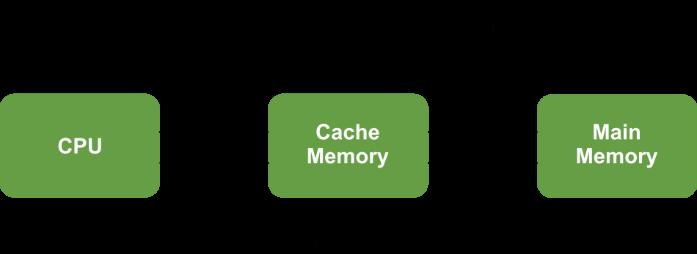
Cache memory is a small, high-speed volatile memory located close to the CPU in a computer system. Its primary purpose is to store frequently accessed data and instructions temporarily, enabling faster data retrieval than would be possible from the main memory (RAM). Cache memory significantly enhances the efficiency and performance of the CPU by reducing the time it takes to access data from the main memory.

Cache memory is a critical component in modern computer architecture, bridging the speed gap between the CPU and main memory. Its strategic location and rapid access capabilities make it indispensable for achieving high performance in computing systems.

There are three types of cache memory:

L1 Cache (Level 1):

  • Located directly on the processor chip.
  • Extremely fast but limited in size, typically ranging from 2 KB to 64 KB.
  • Divided into two parts: Instruction Cache (stores instructions) and Data Cache (stores data).

L2 Cache (Level 2):

  • Slightly slower than L1 but larger, ranging from 256 KB to 8 MB.
  • Can be located on the processor chip or on a separate chip close to the CPU.

L3 Cache (Level 3):

  • Larger and slower than L1 and L2, ranging from 1 MB to 32 MB.
  • Shared among multiple CPU cores in multi-core processors.

Functionality of cache memory :

Cache memory operates on the principle of temporal and spatial locality. Temporal locality refers to the tendency of a processor to access the same memory locations repeatedly within a short period. Spatial locality refers to the tendency of a processor to access memory locations that are close to each other within a short period.

When the CPU needs to read or write data, it first checks whether the data is in the cache (cache hit). If the data is found, it is read or written to the cache memory directly, which is much faster than accessing the main memory. If the data is not found in the cache (cache miss), it is retrieved from the main memory and also stored in the cache for future access.

Benefits of Cache Memory : 

  • Speed: Significantly faster data retrieval compared to main memory.
  • Efficiency: Reduces CPU idle time and increases overall system performance.
  • Power Consumption: Lower energy consumption due to reduced access to slower main memory.

Techniques of cache mapping :

  • Direct Mapping : Each block of main memory maps to only one cache line.
  • Associative Mapping : Any block of main memory can be loaded into any line of the cache.
  • Set-Associative Mapping : Combines aspects of direct and associative mapping.

Comments ()


Sign in

Read Next

Google classroom

Blog banner

Importance of modern technology era

Blog banner

Cloud Technology and its Implications for Entrepreneurship

Blog banner

The Role of cryptography in cyber security

Blog banner

I/O Buffering

Blog banner

Evolution of OS

Blog banner

Deadlock Prevention

Blog banner

Threads

Blog banner

Full Disk Encryption on Digital Forensics

Blog banner

About myself

Blog banner

Power of words

Blog banner

Understanding E-mail Servers

Blog banner

Product Discount Calculator

Blog banner

ART AND CULTURE OF VRINDAVAN

Blog banner

OS assignment 3

Blog banner

Career v/s Job : Choose your passion

Blog banner

INTERRUPTS

Blog banner

Facebook marketing

Blog banner

Modern operating system

Blog banner

Electronic Evidence in Cyber Forensics

Blog banner

Importance Of Blockchain

Blog banner

Smitten Kitchen Keepers

Blog banner

Royal enfield

Blog banner

A little bit of salt is all the hash needs!

Blog banner

Direct Memory Access

Blog banner

A book review

Blog banner

Are Social Media Paid Campaigns Worth It?

Blog banner

Blog on health and fitness

Blog banner

Solving Problems with AI: The Power of Search Algorithms

Blog banner

A BLOG ON MYSQL

Blog banner

Evolution of Operating system

Blog banner

How Puppet Shows and Role Play Teach Empathy to Preschoolers

Blog banner

Theads

Blog banner

Secure Hypertext transfer protocol

Blog banner

Processes : Process description and control

Blog banner

Cache memory

Blog banner

Memory management and virtual memory

Blog banner

Memory management

Blog banner

Importance of self defence for girls

Blog banner

Operating system evolution

Blog banner

Data Analytics in Data Science

Blog banner

Social media

Blog banner