wisemonkeys logo
FeedNotificationProfileManage Forms
FeedNotificationSearchSign in
wisemonkeys logo

Blogs

Deadlock

profile
Vansh Dedhia
Aug 13, 2024
0 Likes
0 Discussions
106 Reads

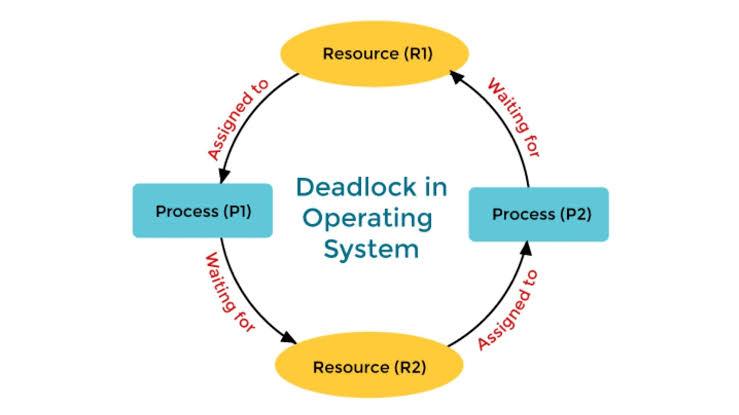
A deadlock in an operating system occurs when a set of processes become stuck in a state where each process is waiting for a resource that another process in the set is holding. As a result, none of the processes can proceed, and they all remain in a state of perpetual waiting.


Deadlock Recovery:

When a deadlock occurs, the system must recover from it to ensure that the processes can eventually complete. There are several methods for deadlock recovery:


1. Process Termination:

   - Abort All Deadlocked Processes: The simplest solution is to terminate all the processes involved in the deadlock. This guarantees recovery but can result in significant work being lost.

   - Abort One Process at a Time: A more refined approach is to abort processes one by one until the deadlock is resolved. The choice of which process to terminate can be based on factors such as the process's priority, the amount of work it has done, or the resources it holds.


2. Resource Preemption:

   - Preempt Resources: Temporarily take resources away from some processes and give them to others. This can break the circular wait condition.

   - Rollback: Roll back one or more processes to an earlier safe state and restart them, allowing the system to avoid deadlock. This method requires the system to maintain sufficient information about the states of processes.


3. Process Migration:

   - Move Processes to Different Systems: In distributed systems, processes can be moved to other systems where the required resources are available. This approach can help avoid deadlock but requires advanced system capabilities.


4. Combination Methods:

   - Sometimes, a combination of process termination and resource preemption might be used to resolve deadlocks more effectively.


The choice of deadlock recovery method depends on the specific system and the criticality of the processes involved.



Comments ()


Sign in

Read Next

Virtual memory

Blog banner

File Systems in OS.

Blog banner

Disk Scheduling

Blog banner

Memory management

Blog banner

Proof-of-Stake (PoS)

Blog banner

OS DESIGN CONSIDERATIONS FOR MULTIPROCESSOR

Blog banner

Traveling

Blog banner

Starvation

Blog banner

10 Survival Tips that might save your life

Blog banner

Process State

Blog banner

Wiretapping

Blog banner

Craziness of dream 11 and how it impacts on our life

Blog banner

Health and fitness

Blog banner

The Power of Forensic Watermarking in the Fight Against Content Piracy

Blog banner

Is Social Media Marketing The Next Wave Of Digital Marketing?

Blog banner

Computer Forensics and its Impact in Business Environment

Blog banner

HACKING MOBILE PLATFORM

Blog banner

Modern operating system

Blog banner

Danger assessment in GIS

Blog banner

Junk food vs healthy food

Blog banner

Different Types of Data

Blog banner

Tea, Coffee, Red Wine, and Teeth: A Stain Survival Guide

Blog banner

OS- Assignnment 1

Blog banner

Evolution of Operating System

Blog banner

Full Disk Encryption

Blog banner

Process Description

Blog banner

Autonomy Vehicles: Future Ki Gadiya

Blog banner

Cryptanalysis tool

Blog banner

Street foods

Blog banner

Service transistion under difficult conditions

Blog banner

I/O Buffering

Blog banner

IOT Hacking Techniques

Blog banner

Computer Security

Blog banner

Importance of Website

Blog banner

Uniprocessor Scheduling

Blog banner

Monday. com App

Blog banner

Electronic data interchange

Blog banner

Blockchain Transactions

Blog banner

MIDDLE CLASS MELODIES!!

Blog banner

Affiliate Marketing V/S Influencer Marketing

Blog banner

Buffer Overflow

Blog banner

Deadlock

Blog banner