
wisemonkeys logo
FeedNotificationProfileManage Forms
FeedNotificationSearchSign in
wisemonkeys logo

Blogs

Docker Framework

profile
Hitanshi Patel
Sep 14, 2022
0 Likes
0 Discussions
142 Reads

What is a Container?

A container is a application used to bundle up all the neccesary files, libraries and services into one runtime environment. As one unit, the container can easily be moved and run on any operating system in any context. They don’t contain a guest OS for each container and rely on the underlying OS kernel, which makes the containers lightweight.Containers share resources with other containers in the same host OS and provide OS-level process isolation.

Important Terminologies in Docker:

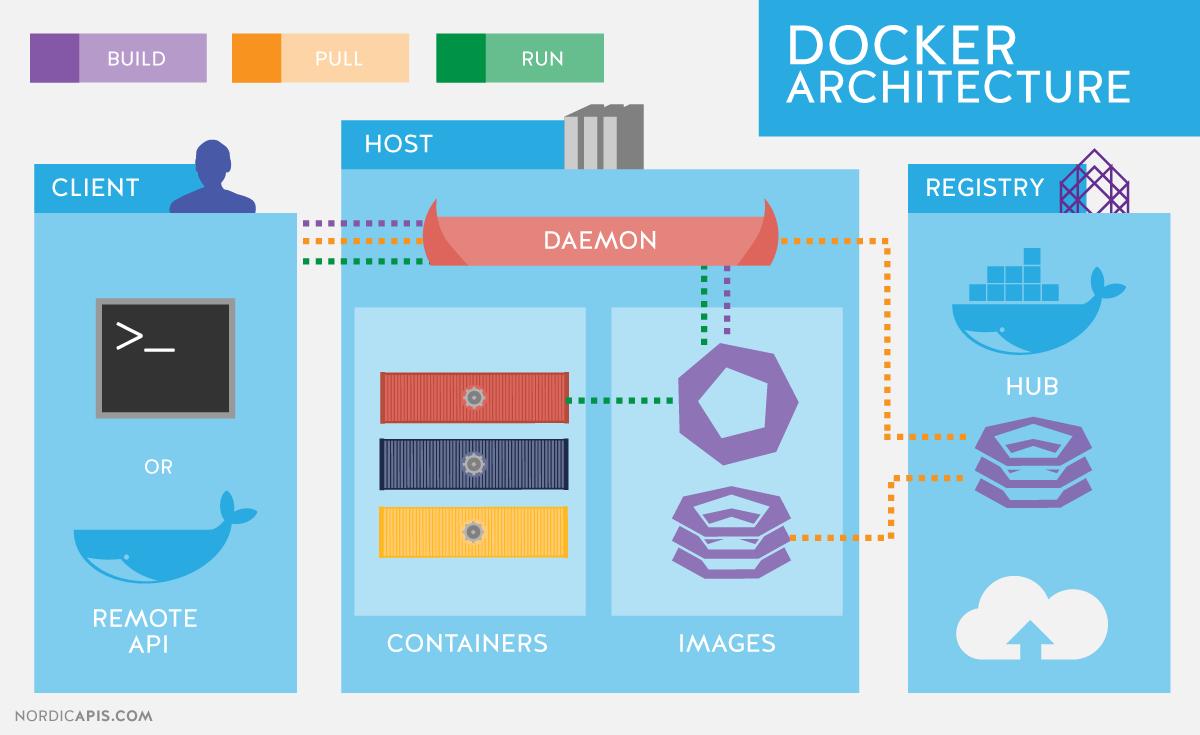
As the image shows, the important terminologies in a docker for it to run are;

Client, Host, Daemon, Registry, Containers and Images

A container is a runnable instance of an image. An image is a read-only template with instructions for creating a Docker container. Often, an image is based on another image, with some additional customization. A Docker registry stores Docker images. Docker Hub is a public registry that anyone can use, and Docker is configured to look for images on Docker Hub by default. You can even run your own private registry.

The Docker client  is the primary way that many Docker users interact with Docker. When you use commands such as docker run, the client sends these commands to dockered, which carries them out. The docker command uses the Docker API. The Docker client can communicate with more than one daemon.The Docker daemon listens for Docker API requests and manages Docker objects such as images, containers, networks, and volumes. A daemon can also communicate with other daemons to manage Docker services.




Comments ()


Sign in

Read Next

Latest Email Marketing Techniques

Blog banner

Craziness of dream 11 and how it impacts on our life

Blog banner

Microsoft powerpoint presentation

Blog banner

Beauty of indian railway

Blog banner

Session Hijacking

Blog banner

Why we should do reading

Blog banner

Utilizing Data-Hiding and Retrieval Techniques in Cyber Forensics

Blog banner

Threads

Blog banner

Types of E-Commerce

Blog banner

Virtual Memory

Blog banner

What is Influencer Marketing and its Trends

Blog banner

BLOCKCHAIN MACHANISM

Blog banner

Interrupts

Blog banner

Python as a tool for Data science task & project

Blog banner

Simple AI Symptom Diagnosis Using LISP – Rule-Based Expert System

Blog banner

Threading

Blog banner

Deadlock

Blog banner

File sharing

Blog banner

Components of GIS

Blog banner

Uniprocessor Scheduling

Blog banner

The Art Of Getting What You Want In Life....

Blog banner

The New Dr. Frankenstein who will perform first full head transplant

Blog banner

TEAMWORK

Blog banner

OPERATING SYSTEM OBJECTIVES AND FAULT TOLERENCE.

Blog banner

Bharat Maps

Blog banner

Data Science in Healthcare: Predicting Diseases

Blog banner

Electronic data interchange

Blog banner

Life lesson

Blog banner

child Labour

Blog banner

Blog on Smartsheet.

Blog banner

Data Visualization in Decision-Making

Blog banner

Virtualisation

Blog banner

Linux

Blog banner

Study on cyber and network forensic in computer security management

Blog banner

What is the point of living if we can die at any moment of our lives ?

Blog banner

Exploring the Power of Encase Forensic Tools: Unraveling Digital Mysteries

Blog banner

10 Amazing facts about Tokyo Ghoul

Blog banner

Data Security and Data Privacy in Data Science

Blog banner

LISP - Library Management System

Blog banner

Junk food vs healthy food

Blog banner

Uniprocessor scheduling

Blog banner

OS Assignment-3

Blog banner