wisemonkeys logo
FeedNotificationProfileManage Forms
FeedNotificationSearchSign in
wisemonkeys logo

Blogs

Virtualisation

profile
Harsh Kanakia
Jul 11, 2023
0 Likes
0 Discussions
28 Reads


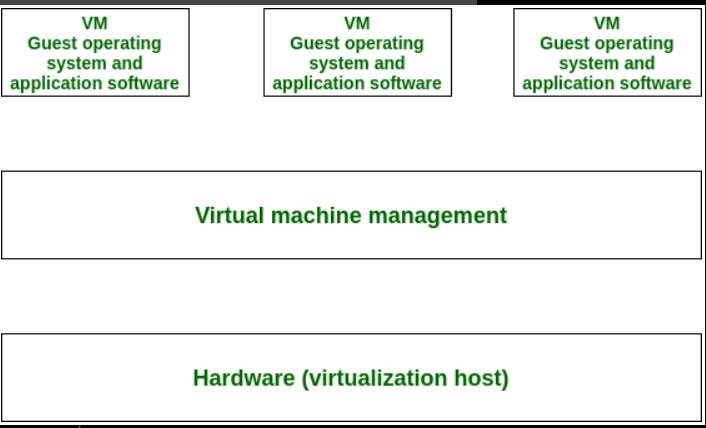
Operating system-based Virtualization refers to an operating system feature in which the kernel enables the existence of various isolated user-space instances. The installation of virtualization software also refers to Operating system-based virtualization. It is installed over a pre-existing operating system and that operating system is called the host operating system. 

In this virtualization, a user installs the virtualization software in the operating system of his system like any other program and utilizes this application to operate and generate various virtual machines. Here, the virtualization software allows direct access to any of the created virtual machines to the user. As the host OS can provide hardware devices with the mandatory support, operating system virtualization may affect compatibility issues of hardware even when the hardware driver is not allocated to the virtualization software. 

Virtualization software is able to convert hardware IT resources that require unique software for operation into virtualized IT resources. As the host OS is a complete operating system in itself, many OS-based services are available as organizational management and administration tools can be utilized for the virtualization host management. 

Various major operations of Operating System Based Virtualization are described below:  

1.Hardware capabilities can be employed, such as the network connection and CPU.
2.Connected peripherals with which it can interact, such as a webcam, printer, keyboard, or Scanners.
3.Data that can be read or written, such as files, folders, and network shares.


 

Features of operating system-based virtualization are:

  • Resource isolation: Operating system-based virtualization provides a high level of resource isolation, which allows each container to have its own set of resources, including CPU, memory, and I/O bandwidth.
  • Lightweight: Containers are lightweight compared to traditional virtual machines as they share the same host operating system, resulting in faster startup and lower resource usage.
  • Portability: Containers are highly portable, making it easy to move them from one environment to another without needing to modify the underlying application.
  • Scalability: Containers can be easily scaled up or down based on the application requirements, allowing applications to be highly responsive to changes in demand.
  • Security: Containers provide a high level of security by isolating the containerized application from the host operating system and other containers running on the same system.

Comments ()


Sign in

Read Next

Privacy in Social Media and Online Services

Blog banner

Importance of Morning Routines for Students During the Festive Season

Blog banner

First-Order Logic (FOL): The Foundation of Modern Logic

Blog banner

Defining youtubr

Blog banner

Top Career Paths After a B.Com Degree in Mumbai: What’s Next for You?

Blog banner

RAID - LEVELS OF RAID

Blog banner

Cycling

Blog banner

Top 3 Places To Stay In Vienna

Blog banner

Southern Turkey Earthquake: Causes and Consequences of a Tragic Natural Disaster

Blog banner

Steganography and Steganalysis

Blog banner

EID UL FITR

Blog banner

DMZ: Your Secret Weapon for Data Security

Blog banner

Big O Notation

Blog banner

You'll get to know about Pankaj Negi

Blog banner

"Audit" In Data Science

Blog banner

A buffer overflow

Blog banner

Virtual Memory

Blog banner

Session Hijacking

Blog banner

Modern operating system

Blog banner

Malware Detection Techniques for Mobile Devices

Blog banner

World’s rarest passport owned by 500 people.

Blog banner

Process Creation

Blog banner

Disk scheduling

Blog banner

Network Forensics

Blog banner

Current Trends in GIS and Remote Sensing(Ocean Applications)

Blog banner

Meal Maharaj — 3 CP, 5 CP, 8 CP. Same Love, Different Portions

Blog banner

A Short History of GIS

Blog banner

Models of Information Security.

Blog banner

Modern operating system

Blog banner

Impacts of Data Breach On Companies Challenges and Prevention

Blog banner

Next time you click on "Remind me later", think twice!

Blog banner

Simple AI Symptom Diagnosis Using LISP – Rule-Based Expert System

Blog banner

Evolution of Operating system

Blog banner

Guidelines for a Low sodium Diet.

Blog banner

ADD A SPICE TO YOUR LIFE.

Blog banner

INTERNET SECURITY

Blog banner

A-B-C of Networking: Part-2 (Components)

Blog banner

BharatPe

Blog banner

Deadlock and Starvation

Blog banner

Google classroom

Blog banner

Theads

Blog banner

Processing Crime and Incident Scenes

Blog banner