wisemonkeys logo
FeedNotificationProfileManage Forms
FeedNotificationSearchSign in
wisemonkeys logo

Blogs

Memory Management

profile
Vrudanshi Bavliya
Aug 14, 2024
0 Likes
0 Discussions
63 Reads

Memory management is the process of controlling and coordinating a computer’s main memory. It ensures that blocks of memory space are properly arranged and allocated so the operating system (OS) , applications and other running processes have the memory they need to carry out their operations. 

 Types of Memory

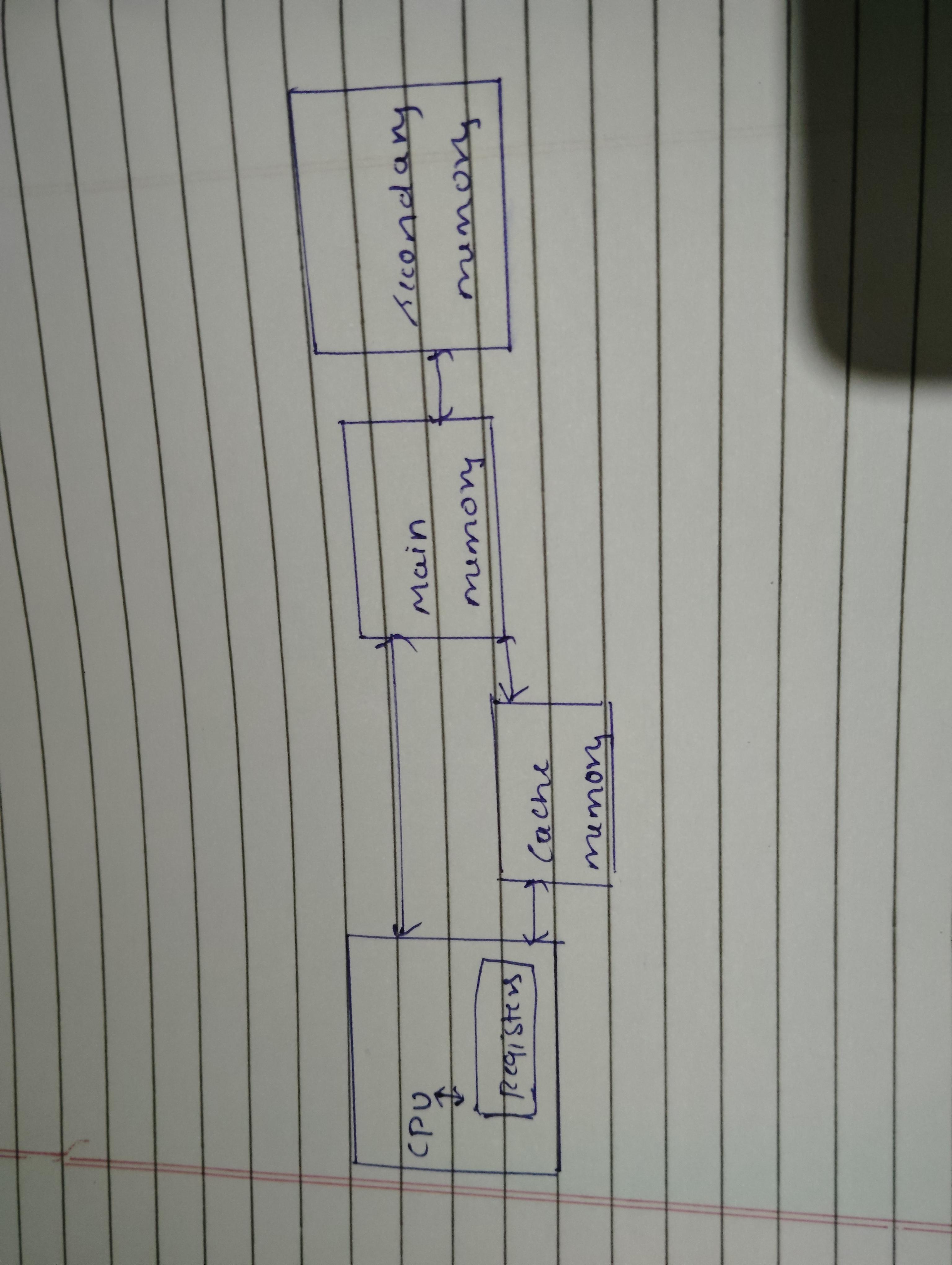
Registers – It is a temporary Storage area built in a CPU access time of register is below 10ns, and registers have lowest capacity that is of few KB of words. 

Cache Memory – It is a high speed memory. The purpose of cache memory is to store those program that are repeatedly used or likely to be used in the near future. 

Main Memory – It is also known as Primary memory or RAM or Physical memory. The CPU can execute only the data that is present in the Main memory . It is the temporary storage location where data of currently running programs are stored for short period of time. 

Secondary Memory – It allows user to store data that can be easily retrieved. This memory cannot be directly used. It can be accessed only by the main memory. For example:- Magnetic tape, magnetic disk, hard disc etc.

Principles for effective memory

Make the common case fast - The principal says that the data which is more frequently used should be kept in faster device. It is based on amdhal's law. 

Principle of locality - It is based on locality of references , According to this, the programs tend to reuse data and instruction they have used recently. 90/10 rule comes from empirical Observation:- a program spends 90% of its time in 10% of its code. An Implication of locality is that we can predict with reasonable accuracy what instructions and data a program will use in the near future based on its accesses in the recent past. 

Two different types of locality

Temporal locality - States that recently accessed items are likely to be accessed in the near future. 

Spatial locality - States that items whose addresses are near one another tend to be referenced closed together in time.




Comments ()


Sign in

Read Next

Denial-of-Service and Distributed Denial-of-Service Attack Techniques

Blog banner

Zomato (Income Sources)

Blog banner

Multiprocessor and Multicore Organization

Blog banner

Design Considerations for Disk Cache Management

Blog banner

Online Games

Blog banner

Virtual memory in os

Blog banner

note taker app

Blog banner

1.1 basic elements

Blog banner

Self-love: Being the reason of your own smile

Blog banner

Vulnerability Assessment

Blog banner

Studying Denial of service attack using DOSHTTP tool

Blog banner

File Management In OS

Blog banner

The Secure Software Development Life Cycle (SDLC)

Blog banner

Not anti-social, but pro-solitude

Blog banner

Operating system and overviews

Blog banner

What is Influencer Marketing and its Trends

Blog banner

Cyber Forensics in Healthcare: Protecting Patient Data and Preventing Breaches

Blog banner

Electronic data interchange

Blog banner

OS DESIGN CONSIDERATIONS FOR MULTIPROCESSOR

Blog banner

Os(Computer security threats)

Blog banner

Random Forests

Blog banner

Virtual Memory

Blog banner

Race Conditions

Blog banner

c

Blog banner

Uber

Blog banner

Service Catalogue Management

Blog banner

ARTICAL ON MANAGEMENT SYSTEM

Blog banner

Concurrency and Deadlocks

Blog banner

operating system

Blog banner

Technical SEO : Total Guide

Blog banner

Mumbaicha Dabbawalla

Blog banner

The Right way of cooking

Blog banner

Domain Name System

Blog banner

Embedded Operating System

Blog banner

Bots and Cyber Security

Blog banner

The Procedural Framework for Corporate High-Tech Investigations

Blog banner

MD5 Collisions and the impact on computer forensics

Blog banner

Theads

Blog banner

Data Lakes: A Key to Modern Data Management

Blog banner

File Management system

Blog banner

Super Garlicky Tomato Soup with Smashed White Beans

Blog banner

Volatile Memory & Non-Volatile Memory Explained

Blog banner