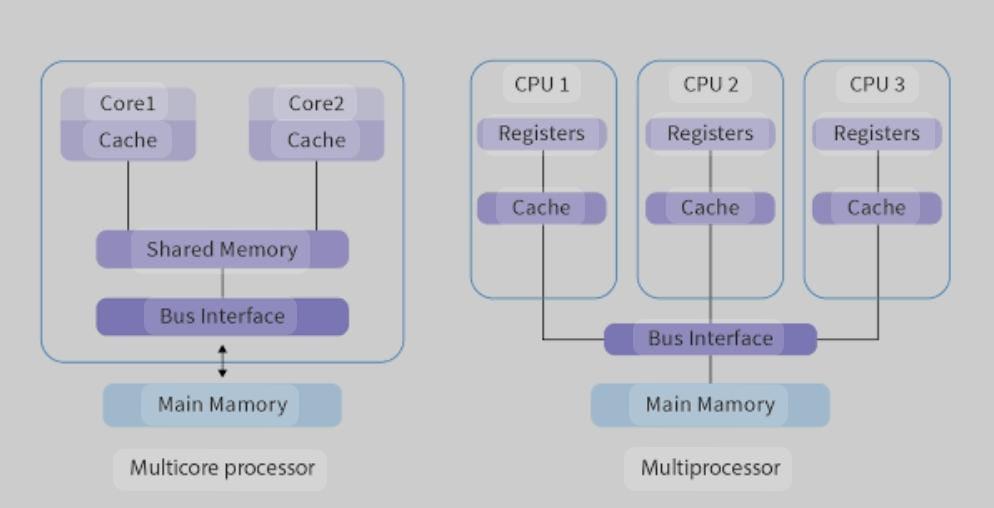
There are two methods for creating systems of computers with multiple processors or processor cores: multiprocessor organization and multicore organization. Both strategies aim to boost a computer's processing power by enabling it to handle several tasks at once.
Multiprocessor System
A system with a multiprocessor has several CPUs or processors. These systems execute multiple instructions concurrently. Throughput improves as a result. The remaining CPUs will keep operating normally even if one CPU fails. Multiprocessors are therefore more dependable.
· A multiprocessor system's processing power increases significantly because more tasks may be carried out simultaneously by more processors working in parallel.
· Workloads can be distributed more evenly among several processors in a multiprocessor system, maximizing the usage of system resources.
· A multiprocessor system's design and implementation are more difficult than those of one processor system.
· Task synchronization and coordination across numerous processors can be difficult, especially when using shared resources.
A multi-core processor is a single computing device with many cores (separate processing units). It indicates that the system has a single CPU with several cores. These cores can each read and execute instructions from a computer. Despite being cores rather than processors, they function in a way that gives the impression that the computer system has multiple processors. These cores can carry out regular processor operations like a branch, move data, and add data.
· A multicore system's processing capability is considerably increased by its ability to carry out numerous tasks concurrently.
· By enabling more effective system resource use and removing bottlenecks, multicore systems can boost performance.
· Older software that wasn't created for multicore systems may cause compatibility problems and poor performance.
· Cache coherency must be preserved when several cores reference the same memory location in order to guarantee that every core has access to the most recent data.
Comparison between the Multiprocessors and Multicore Systems
Definition:
Multiprocessor:- It is a system with multiple CPUs that allows processing programs simultaneously.
Multicore:- A multicore processor is a single processor that contains multiple independent processing units known as cores that may read and execute program instructions.
Execution:
Multiprocessors:-Multiprocessors run multiple programs faster than a multicore system.
Multicore:- The multicore executes a single program faster.
Reliability:
Multiprocessors:- It is more reliable than the multicore system. If one of any processors fails in the system, the other processors will not be affected.
Multicore:- It is not much reliable tdhan the multiprocessors.
Cost:
Multiprocessors:- It is more expensive as compared to a multicore system.
Multicore:- These are cheaper than the multiprocessors system.