wisemonkeys logo
FeedNotificationProfileManage Forms
FeedNotificationSearchSign in
wisemonkeys logo

Blogs

Processes : Process description and control

profile
4475 Mit Gohil
Jul 05, 2024
0 Likes
0 Discussions
51 Reads

Processes in the context of computing refer to instances of executing programs on a computer system. Each process has its own memory space, resources, and execution context. Here's a breakdown of the key aspects related to processes:

  1. Process Description:
    • Program Execution: A process represents the execution of a program. It includes the program code, associated data, and resources like open files and network connections.
    • Memory Space: Each process typically has its own memory space, which includes the executable code, variables, stacks, heaps, etc.

    • Resource Allocation: Processes may require various system resources (CPU time, memory, files) which are allocated to them by the operating system.

      • Process ID (PID): A unique identifier assigned to each process by the operating system, which helps in managing and distinguishing between different processes.

      2.Process Control:

      • Creation: Processes are created either by the operating system when a program is started or by another process (parent process) using system calls like fork() (Unix-like systems) or CreateProcess() (Windows).
      • Scheduling: The operating system scheduler decides which process gets to use the CPU and for how long, based on scheduling algorithms (e.g., round-robin, priority-based scheduling).

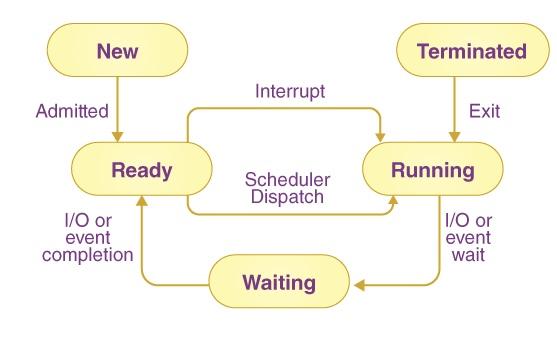
        Execution State: Processes transition between different states such as running, ready, waiting (blocked), or terminated. State transitions are managed by the operating system scheduler and are influenced by events like I/O operations, timers, and signals.

      • Termination: Processes can terminate either voluntarily (by calling exit) or involuntarily (due to errors or signals). Upon termination, resources allocated to the process are released by the operating system.                       

        3. Process Communication and Synchronization:

        • Processes often need to communicate and synchronize with each other, especially in multi-process or multi-threaded environments.
        • Mechanisms for inter-process communication (IPC) include shared memory, message passing (pipes, sockets, message queues), and synchronization primitives (mutexes, semaphores) to coordinate access to shared resources.

          4.Process States:

          • Running: The process is currently executing instructions on the CPU.
          • Ready: The process is ready to execute and waiting for its turn to be assigned to a CPU core.
          • Waiting (Blocked): The process is waiting for an event (such as I/O completion) or resource allocation (like memory) before it can proceed.
          • Terminated: The process has finished execution, and its resources have been released back to the system.
          • Understanding processes and their control is fundamental to operating system design, resource management, and application development, especially in ensuring efficient and stable execution of programs on a computer system.



Comments ()


Sign in

Read Next

Analysis of Digital Evidence In Identity Theft Investigations

Blog banner

Internet of Things and cyber security

Blog banner

A BLOG ON MYSQL

Blog banner

Virtual Machine

Blog banner

Importance of Network Security Risk

Blog banner

Penetration Testing

Blog banner

The Importance of Financial Literacy for College Students

Blog banner

Deadlock

Blog banner

GEOLOGY AND GEO-TECTONIC FRAME WORK OF WESTERN BASTAR CRATON

Blog banner

Rules and Regulations of Networking: "Standards and Protocols" - Part 2

Blog banner

Super Garlicky Tomato Soup with Smashed White Beans

Blog banner

Business Intelligence v/s Big Data

Blog banner

Understanding Mobile Device Forensics

Blog banner

OS PROCESS DESCRIPTION AND CONTROL-SARVAGYA JALAN

Blog banner

Proton mail

Blog banner

Yoga in INDIA and ABROAD

Blog banner

(Input/Output) in os

Blog banner

Photorec - media recovery tool

Blog banner

The Future of Cybersecurity: Trends, Challenges, and Strategies

Blog banner

Broken Authentication Attacks

Blog banner

Data Storytelling: Turning Analysis into Business Action

Blog banner

NodeJs

Blog banner

Process in OS

Blog banner

Man is free by the birth .

Blog banner

Old age lifestyle

Blog banner

Jira service Management

Blog banner

Electronic Funds Transfer

Blog banner

Cyber Forensics on IOT Devices

Blog banner

The Role of Frontline Managers in Driving Workplace Performance and Customer Satisfaction

Blog banner

I/O buffer and its techniques

Blog banner

Oracle Corporation

Blog banner

Modern operating system

Blog banner

Smart Homes | Zigbee Alliance

Blog banner

Embedded Operating System

Blog banner

HACKING MOBILE PLATFORM

Blog banner

First-Order Logic (FOL): The Foundation of Modern Logic

Blog banner

Save Girl Child

Blog banner

DATA VAULT

Blog banner

Mumbai

Blog banner

Is Pursuing a Dance Career in India Worth it?

Blog banner

Mendeley (management software)

Blog banner

BUSINESS MODELS OF E COMMERCE

Blog banner