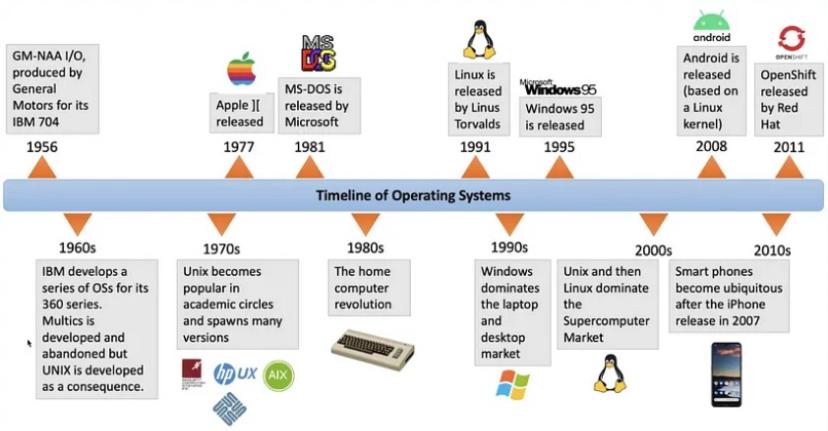
An operating system is a type of software that acts as an interface between the user and the hardware. It is responsible for handling various critical functions of the computer and utilizing resources very efficiently so the operating system is also known as a resource manager. The operating system also acts like a government because just as the government has authority over everything, similarly the operating system has authority over all resources. Various tasks that are handled by OS are file management, task management, garbage management, memory management, process management, disk management, I/O management, peripherals management, etc. The operating system has evolved greatly throughout the years and has gotten better and better in the passing years. The generation of operating systems can be separated into four generations, which are as follows:
A) The first generation (1940 to early 1950) - The first electrical computer didn't have an operating system in 1940. Early computer users had complete control over the device and they wrote programs in pure machine language for every task.
B) the second generation (1955 to 1965) - GMOSIS, the first operating system developed in the early 1950s. For the IBM Computer, General Motors created the operating system.
C) the third generation (1965 to 1980) - operating system designers were able to create a new operating system in the late 1960s that was capable of multiprogramming and the simultaneous execution of several tasks in a single computer program.
D) the fourth generation (1980 to present day) - The development of Microsoft and the Windows operating system was a significant influence on the creation of personal computers. In 1975, Microsoft developed the first Windows operating system MS-DOS. MS-DOS was released in 1981, but users found it extremely challenging to learn its complex commands. Windows is now the most widely used and well-liked operating system available. Windows has released several operating systems, including Windows 95, Windows 98, Windows XP, Windows 7, and Windows 10. The most recent operating system is Windows 11. Apple also has a well-known operating system called Mac OS.
There are different types of operating systems which are as follows :
1. batch processing system - With the growth of time, batch processing systems came onto the market. Now users had the facility to write their programs on punch cards and load them on the computer operator. Then the operator makes different batches of similar types of jobs and then serves the different batches individually to the CPU. CPU first executes jobs in one batch and then jumps to jobs in another batch in a sequenced manner.
2. multiprogramming systems - Multiprogramming was the first operating system where the actual revolution began. It allows the user to load multiple programs into the memory and provide a specific portion to each program.
3. Time-sharing system - The time-sharing system is an extended version of the multiprogramming system. Here one extra feature was added to avoid the use of CPU for a long time by any single program and give access to the CPU to every program after a certain interval of time.
4. introduction of GUI - With the growth of time, Graphical User Interfaces (GUIs) came. First time OS became more user-friendly and changed the way people interact with computers. GUI provides computer system visual elements that make the user’s interaction with the computer more comfortable and user-friendly. Users can click on visual elements rather than typing commands.
5. mobile operating system - The invention of smartphones created a big revolution in the software industry. To handle the operation of smartphones, a special type of operating system was developed. Some of them are iOS and Android etc.
6. AI integration - With the growth of time, artificial intelligence came into the picture. The operating system integrates features of AI technology like Siri, Google Assistant, and Alexa and has become more powerful and efficient in many ways. These AI features with the operating system create an entirely new feature like voice commands, predictive text, and personalized recommendations.