
What is Cryptography
Cryptography in cyber security refers to the practice of using mathematical techniques and algorithms to secure digital information and communications by transforming it into a form that is unreadable to unauthorized parties. It plays a vital role in ensuring the confidentiality, integrity, authentication, and non-repudiation of sensitive data in various digital environments. Cryptography forms the foundation of many security mechanisms and protocols used to protect information from cyber threats.
Working of Cryptography
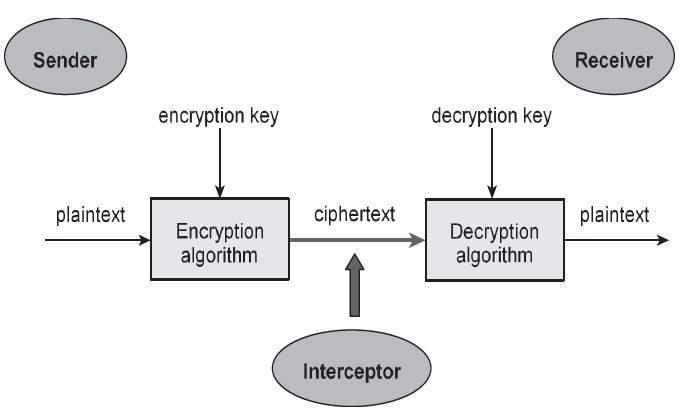
Encryption and decryption are the two procedures involved in cryptography. A cypher is used throughout the encryption process to encrypt plain text and convert it into cypher text. Decryption, on the other hand, transforms the cypher text back into plain text using the same cypher.
Meaning that: A is shifted to D
B is shifted to E
C is shifted to F
D is shifted to G
E is shifted to H
F is shifted to I
G is shifted to J
H is shifted to K
Example:
By applying this cipher, our plain text “Hello” gets converted into cipher text “Khoor” Now, to the untrained eye “Khoor” means nothing like “hello”. However one with the knowledge of Shift cipher could easily decrypt this message
Symmetric key cryptography
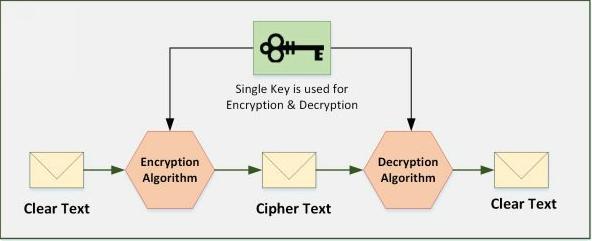
In symmetric key cryptography, the same secret key is used for both encryption and decryption of data. This means that the sender and the recipient must both possess and share the same secret key. The security of symmetric cryptography relies on keeping the key secret. Examples of symmetric encryption algorithms include DES, AES, and 3DES
Asymmetric key cryptography
In this approach, information is encrypted and decrypted using a pair of keys. The public key of a receiver is used for encryption, and the private key is used for decryption. Private Key and Public Key are distinct. Even if everyone knows the public key, only the intended recipient can decode the message because only he has access to the private key. The RSA algorithm is the most widely used asymmetric key encryption algorithm.
Encryption Algorithm
Ciphers: A cypher is a set of guidelines used to carry out encryption. On the internet, there are thousands different cypher algorithms. While some of them are open source, others are proprietary.
Substitution:This approach replaces every character in the data with a different character. A very straightforward illustration in this approach would be to swap out the character by moving it three characters upstream. Thus, "D" would take the place of "A," and so forth. We can choose specific letters to be replaced throughout the text to add complexity. In this case, the key's value is three, and both nodes must be aware of it in order for the data to be decrypted.
Stream Cipher: A kind of symmetric key cypher that encrypts each individual character of plain text. There are many different kinds of stream cyphers, including synchronous and asynchronous ones. The most popular stream cypher design is RC4. During the encryption cycle, the encrypted output's transformation changes.
Block Cipher: A symmetric key cypher type that encrypts plain text on a defined length of the group. In a block cypher, the way that encrypted data is transformed is constant. The same key is used on each block of data to encrypt it. The most popular types of block cypher designs are DES and AES.
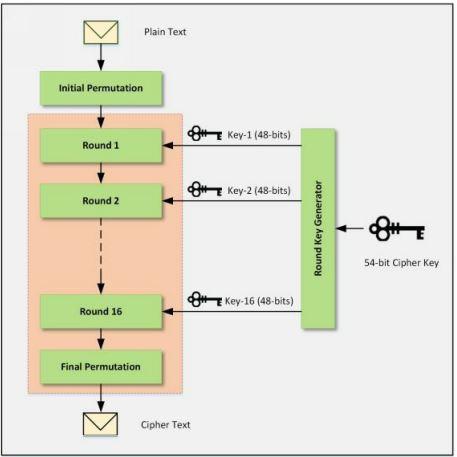
Data Encryption Algorithm (DES) is a symmetric key algorithm that was once used for encryption, however it is now regarded as insecure. Triple DES and G-DES have since taken its place. The 56-bit key size used by DES is insufficient to preserve data consistency. The DES method uses 16 rounds of 48-bit intermediary round keys that are created from a 56-bit cypher key by a round key generator to process the data. Similar to this, the DES reverse cypher uses the same cypher key to compute the data from the cypher text in clear text format.
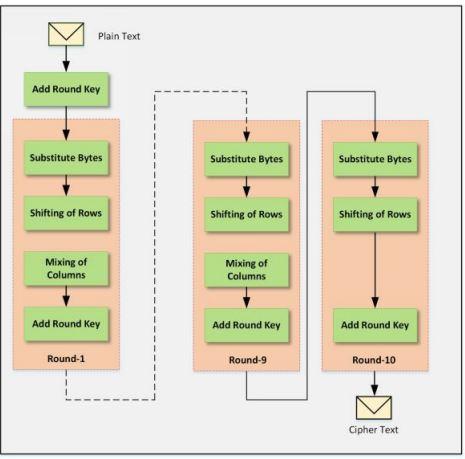
Advanced Encryption Algorithm :There was a need for a different encryption method that is more secure and efficient than DES when DES became vulnerable and performing DES encryption three times (3-DES or Triple-DES) required considerable computation and time. In 2000–2001, "Rijndael" released the Advanced Encryption Algorithm (AES), a novel algorithm. Although Triple-DES is a Private Key Symmetric Algorithm, AES is more powerful and quick. AES has 128/192/256 bit keys and can encrypt data up to 128 bits.
Digital Signature Algorithm (DSA) is an asymmetric cryptographic algorithm that is used to create digital signatures. Digital signatures are used to verify the authenticity of a message or document and to ensure that it has not been modified since it was sent.
DSA is based on the difficulty of calculating discrete logarithms in a finite field. The algorithm generates two keys: a public key and a private key. The public key can be shared with anyone, while the private key must be kept secret.
To create a digital signature, the sender uses their private key to encrypt a hash of the message or document. The hash is a unique fingerprint of the message or document that cannot be easily changed. The encrypted hash is then attached to the message or document.
Here are some additional examples of how cryptography is used in different applications:
Cryptography is a critical tool for protecting data in the modern world. By understanding the basics of cryptography and how it is used in different applications, we can better protect ourselves from cyber threats.