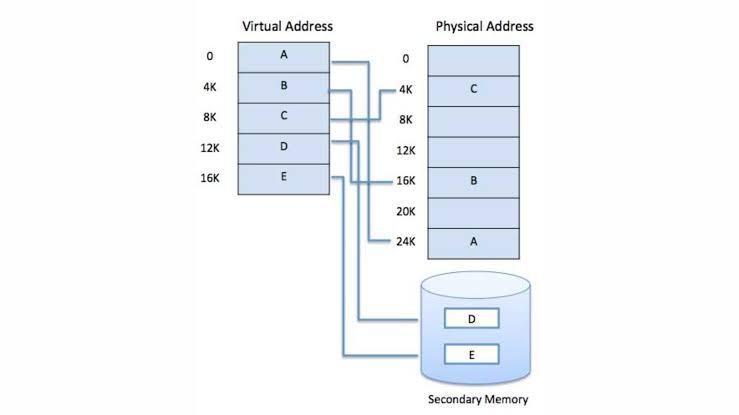
Virtual memory is a memory management technique used by operating systems to give the appearance of a large, continuous block of memory to applications, even if the physical memory (RAM) is limited. It allows the system to compensate for physical memory shortages, enabling larger applications to run on systems with less RAM.
A memory hierarchy, consisting of a computer system’s memory and a disk, enables a process to operate with only some portions of its address space in memory. A virtual memory is what its name indicates- it is an illusion of a memory that is larger than the real memory. We refer to the software component of virtual memory as a virtual memory manager. The basis of virtual memory is the noncontiguous memory allocation model. The virtual memory manager removes some components from memory to make room for other components.
The size of virtual storage is limited by the addressing scheme of the computer system and the amount of secondary memory available not by the actual number of main storage locations.
Working of Virtual Memory
It is a technique that is implemented using both hardware and software. It maps memory addresses used by a program, called virtual addresses, into physical addresses in computer memory.
All memory references within a process are logical addresses that are dynamically translated into
physical addresses
at run time. This means that a process can be swapped in and out of the main memory such that it occupies different places in the main memory at different times during the course of execution.
A process may be broken into a number of pieces and these pieces need not be continuously located in the main memory during execution. The combination of dynamic run-time address translation and the use of a page or segment table permits this.
If these characteristics are present then, it is not necessary that all the pages or segments are present in the main memory during execution. This means that the required pages need to be loaded into memory whenever required. Virtual memory is implemented using Demand Paging or Demand Segmentations .