
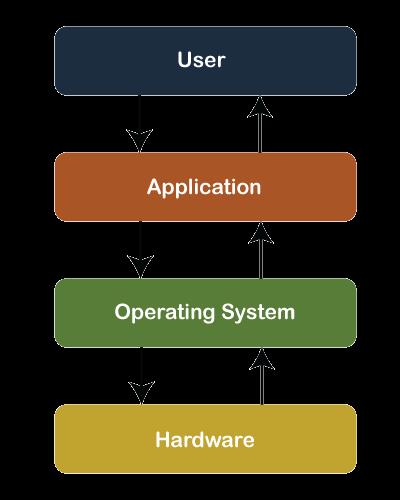
An Operating System is a software program that interacts with hardware such as CPU, memory and peripherals and acts as an interface between application programs and hardware.
It controls the execution of programs loads them into memory executes it requests and also decides CPU and memory space allocation.
OS provides GUI or CLI interface that user interact with computers.
The changes in Operating Systems were brought by several factors such as advancements in hardware, applications and security:
1.Multiprocessor Systems and Increased Speed:
The OS must be able to efficiently use the computing power of multiple resources distributing tasks efficiently for parallel doing of tasks.
2.High Speed Networks:
The growth of high speed networking mandates the OS to handle the incoming data at faster rates.
3.Advanced and Varied Storage:
OS needs to handle the advanced storage options such as Hard Drives, SSD and Cloud Storage in efficient manner.
4. Multimedia Applications:
Demands for real-time processing and high-performance I/O handling to support audio, video, and graphics.
5.Internet Access:
Increased internet access by devices leads to a range to security threats like malware, hacking etc, OS must be capable of safeguarding system.
Design Adopted by Operating Systems in Response to Factors:
1.Microkernel Architecture:
In this architecture, the OS core kernel is assigned only essential functionalities such as memory management, process scheduling and Inter process communication and other functions such as file management run in user space. Unlike, monolithic kernel where all OS services are bundled in the kernel.
2.Multithreading:
Multithreading is a concept of Modern OS that allows a CPU to execute multiple threads concurrently potentially speeding up execution. Thread is a basic unit of CPU utilization(sequence of instructions) multiple threads within a process share the same memory space.
3. Symmetric Multiprocessing:
SMP is architecture that utilizes multiple processors(CPU) within a single system. They share memory, OS allowing them to work on tasks simultaneously.
OS identifies tasks in programs and assigns them to processors. This allows multiple tasks to be executed concurrently and since they share memory they can directly access and modify data leads to efficient communication.
4.Object Oriented Design:
In OS, this allows for creation of reusable components(objects) that cab be easily added without modifying the entire system.
OS components can be customized through inheritance allowing developers to extend base functionalities.
Commonly Device Drivers, File System and Processes are implemented with Object Oriented practices.