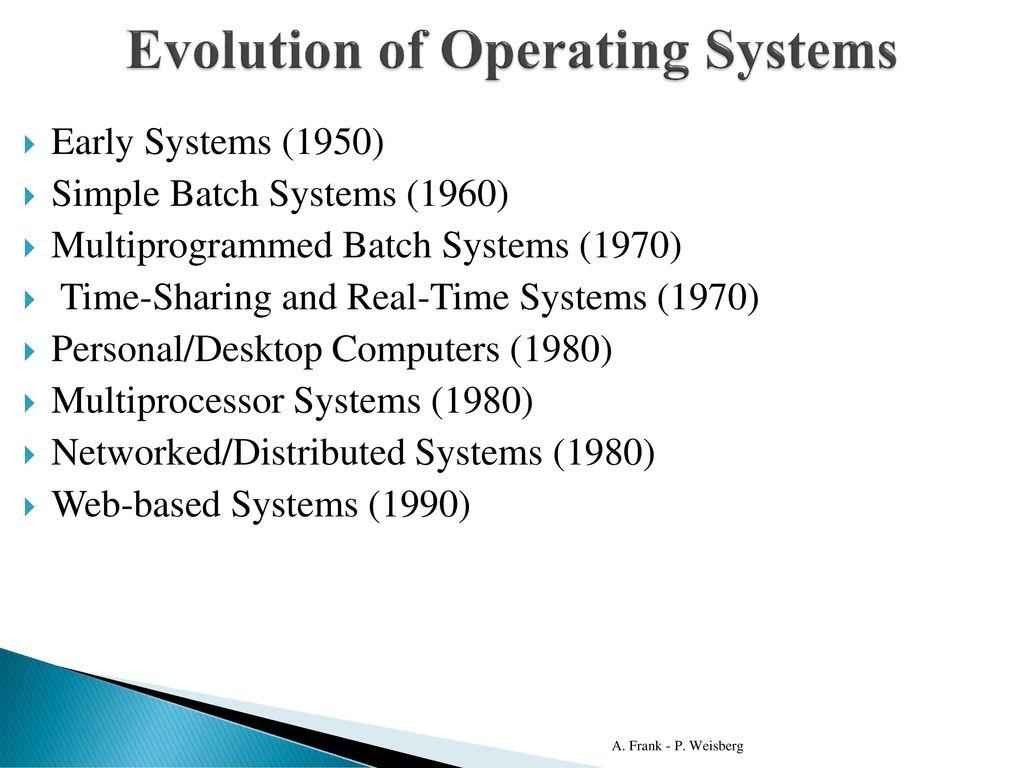
The Evolution of Operating SystemsThe evolution of operating systems (OS) reflects the rapid advancements in computer technology, shaping how users interact with machines and influencing the design and functionality of modern computing. This evolution can be traced from the earliest systems in the 1950s to today's sophisticated multi-user, multi-tasking environments.Early Beginnings: Batch Processing SystemsIn the 1950s and early 1960s, operating systems were primitive compared to today's standards. Computers were primarily used for specific, batch-oriented tasks, and OSs mainly facilitated these tasks. Early systems like the General Motors Operating System for the IBM 701 and MIT's Compatible Time-Sharing System (CTSS) were among the first to manage job scheduling and resource allocation. These batch processing systems allowed multiple jobs to be processed sequentially, reducing idle time by automatically loading the next job as soon as the current one completed.The Advent of Time-Sharing SystemsThe 1960s and 1970s saw a significant shift towards time-sharing systems, enabling multiple users to interact with the computer simultaneously. This development was a milestone in the evolution of OSs. Systems like Multics (Multiplexed Information and Computing Service) and UNIX emerged, introducing concepts such as multitasking and multi-user support. UNIX, in particular, became foundational due to its portability, simplicity, and modularity, influencing many subsequent operating systems.Personal Computing and Graphical User InterfacesThe 1980s marked the rise of personal computing, which dramatically transformed operating systems. With the introduction of microprocessors, computers became more accessible to individuals and small businesses. Microsoft's MS-DOS dominated this era, providing a simple command-line interface for personal computers. However, the need for a more user-friendly experience led to the development of graphical user interfaces (GUIs).Apple's Macintosh, released in 1984, was a pioneer in this regard, offering an intuitive GUI that made computing more accessible to non-technical users. Microsoft followed with Windows, which built upon DOS but provided a graphical layer that revolutionized user interaction.Networked and Distributed SystemsThe 1990s and early 2000s saw the rise of networked and distributed systems. As the internet grew, operating systems adapted to facilitate networking capabilities. This era saw the development of operating systems like Windows NT, which offered robust networking features, and Linux, an open-source UNIX-like OS that gained popularity for its flexibility and security. The proliferation of networked environments required OSs to manage resources and security in more complex, interconnected ways.Modern Operating SystemsToday, operating systems have evolved into highly sophisticated software capable of managing extensive resources and supporting a wide range of applications and devices. Modern OSs like Windows, macOS, Linux, and various mobile OSs (iOS and Android) offer advanced features such as virtualization, enhanced security, and seamless integration with cloud services. The rise of mobile computing has introduced new challenges and opportunities, leading to the development of operating systems optimized for mobile devices.Future TrendsLooking ahead, the evolution of operating systems will likely be shaped by emerging technologies such as artificial intelligence, quantum computing, and the Internet of Things (IoT). These advancements will require OSs to become even more adaptable, efficient, and secure, managing increasingly complex tasks and vast amounts of data.ConclusionThe evolution of operating systems reflects the broader trajectory of computing technology, from the early batch processing systems to the sophisticated, networked, and user-friendly environments we have today. As technology continues to advance, operating systems will remain at the forefront, driving innovation and shaping the future of human-computer interaction.The Evolution of Operating SystemsThe evolution of operating systems (OS) reflects the rapid advancements in computer technology, shaping how users interact with machines and influencing the design and functionality of modern computing. This evolution can be traced from the earliest systems in the 1950s to today's sophisticated multi-user, multi-tasking environments.Early Beginnings: Batch Processing SystemsIn the 1950s and early 1960s, operating systems were primitive compared to today's standards. Computers were primarily used for specific, batch-oriented tasks, and OSs mainly facilitated these tasks. Early systems like the General Motors Operating System for the IBM 701 and MIT's Compatible Time-Sharing System (CTSS) were among the first to manage job scheduling and resource allocation. These batch processing systems allowed multiple jobs to be processed sequentially, reducing idle time by automatically loading the next job as soon as the current one completed.The Advent of Time-Sharing SystemsThe 1960s and 1970s saw a significant shift towards time-sharing systems, enabling multiple users to interact with the computer simultaneously. This development was a milestone in the evolution of OSs. Systems like Multics (Multiplexed Information and Computing Service) and UNIX emerged, introducing concepts such as multitasking and multi-user support. UNIX, in particular, became foundational due to its portability, simplicity, and modularity, influencing many subsequent operating systems.Personal Computing and Graphical User InterfacesThe 1980s marked the rise of personal computing, which dramatically transformed operating systems. With the introduction of microprocessors, computers became more accessible to individuals and small businesses. Microsoft's MS-DOS dominated this era, providing a simple command-line interface for personal computers. However, the need for a more user-friendly experience led to the development of graphical user interfaces (GUIs).Apple's Macintosh, released in 1984, was a pioneer in this regard, offering an intuitive GUI that made computing more accessible to non-technical users. Microsoft followed with Windows, which built upon DOS but provided a graphical layer that revolutionized user interaction.Networked and Distributed SystemsThe 1990s and early 2000s saw the rise of networked and distributed systems. As the internet grew, operating systems adapted to facilitate networking capabilities. This era saw the development of operating systems like Windows NT, which offered robust networking features, and Linux, an open-source UNIX-like OS that gained popularity for its flexibility and security. The proliferation of networked environments required OSs to manage resources and security in more complex, interconnected ways.Modern Operating SystemsToday, operating systems have evolved into highly sophisticated software capable of managing extensive resources and supporting a wide range of applications and devices. Modern OSs like Windows, macOS, Linux, and various mobile OSs (iOS and Android) offer advanced features such as virtualization, enhanced security, and seamless integration with cloud services. The rise of mobile computing has introduced new challenges and opportunities, leading to the development of operating systems optimized for mobile devices.Future TrendsLooking ahead, the evolution of operating systems will likely be shaped by emerging technologies such as artificial intelligence, quantum computing, and the Internet of Things (IoT). These advancements will require OSs to become even more adaptable, efficient, and secure, managing increasingly complex tasks and vast amounts of data.ConclusionThe evolution of operating systems reflects the broader trajectory of computing technology, from the early batch processing systems to the sophisticated, networked, and user-friendly environments we have today. As technology continues to advance, operating systems will remain at the forefront, driving innovation and shaping the future of human-computer interaction.