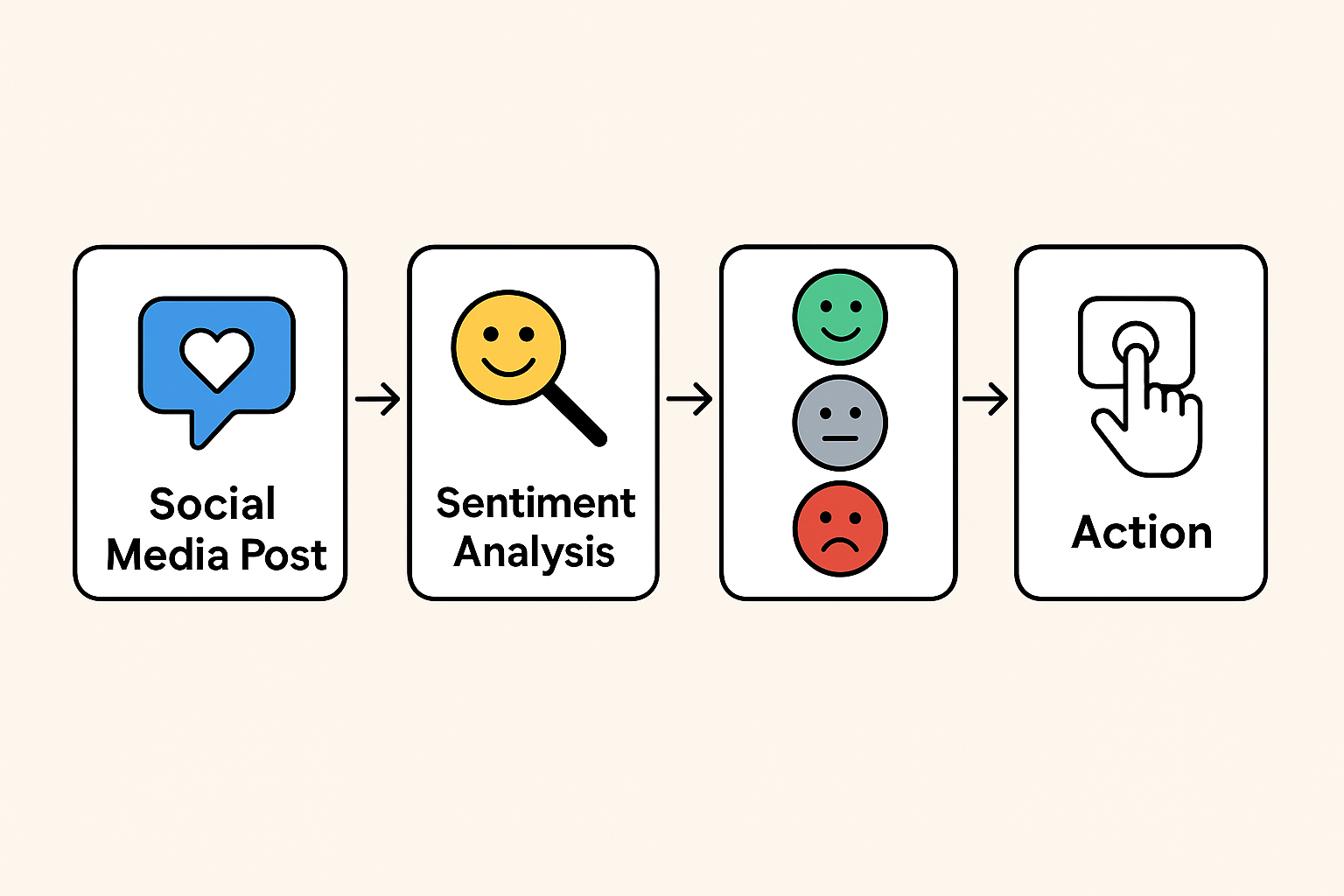
Social media sentiment analysis is a way to find out what people feel when they post online. It uses computer programs to read comments, reviews, and posts and decide if they are positive, negative, or neutral. This helps companies understand what customers think about their products or services.
Every day, millions of people talk on Facebook, Twitter, Instagram, and other platforms. These opinions are very useful for businesses. By studying them, companies can learn if people like their brand, see what customers want, and quickly fix problems.
1. Collecting Data – Taking posts, reviews, or comments from social media.
2. Processing Data – Using computer tools to check if the text is positive, negative, or neutral.
3. Insights – Understanding what the results mean and deciding what action to take.
• Be Accurate – Use good tools and correct data.
• Understand Context – Words can mean different things in different situations.
• Take Action – Use the results to make changes or improvements.
• Be Quick – Real-time results help in reacting faster.
Some popular tools are:
• Simple libraries like TextBlob and spaCy
• Platforms like Brandwatch and Sprout Social
• AI services like Google Cloud NLP and IBM Watson
• Not understanding jokes or sarcasm.
• Ignoring comments in other languages.
• Trusting only computer results without checking.
• Looking only at the number of comments, not their meaning.
• Shows how customers feel in real time.
• Helps protect the brand’s reputation.
• Builds stronger connections with customers.
• Improves marketing and sales decisions.
• Smarter tools that can understand sarcasm and humor.
• Studying not only text but also images and videos.
• Real-time dashboards to predict customer behavior.
• Using AR/VR to study customer experiences.
A company launches a new phone. After two days, 10,000 tweets are collected.
• 70% are positive, 20% are neutral, and 10% are negative.
• The company then gives special offers, which improves the brand image.
Social media sentiment analysis turns online posts into useful ideas. It helps companies know what customers feel, change their strategies, and make people happier.
Data → Feelings → Action = Better Results.
Example 1: Restaurant Reviews
Imagine 100 people share reviews about a restaurant:
- 60% Positive (Good food, friendly staff)
- 25% Neutral (Okay experience)
- 15% Negative (Slow service, high price)
The restaurant owner can use this to improve service and offer discounts.
After a movie release, people post online:
- 70% Positive (Great acting, storyline)
- 20% Neutral (Average movie)
- 10% Negative (Too long, boring)
Producers can use this feedback to market better or adjust promotions.
Customers review a new gadget online:
- 65% Positive (Good quality, fast delivery)
- 20% Neutral (Okay but nothing special)
- 15% Negative (Defective pieces, poor packaging)
The seller can solve issues quickly and improve future sales.