wisemonkeys logo
FeedNotificationProfileManage Forms
FeedNotificationSearchSign in
wisemonkeys logo

Blogs

Linux Virtual Machine Process Scheduling

profile
Krishi Nagda
Aug 15, 2024
0 Likes
0 Discussions
66 Reads

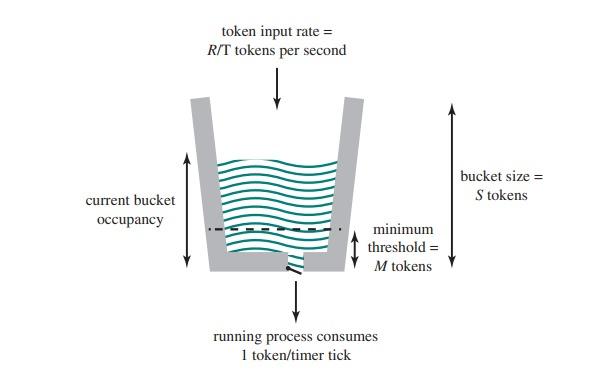
In the Linux VServer virtual machine (VM) facility, the allocation of processor time to multiple VMs is managed using a Token Bucket Filter (TBF). This system ensures that each VM receives a fair share of processing resources, particularly in environments with single or multicore processors.


Fraction of Processor Allocation

Processor Allocation Formula: The ratio of token generation rate (R) to the time interval (T) determines the fraction of a single processor's capacity allocated to a VM: 

R/T = Fraction of processor allocation


Linux VServer Token Bucket Scheme

For example, in a system with four cores, if a VM is intended to use the equivalent of one full core, R is set to 1, and T is set to 4.  

Overall System Limitation: The total fraction of processor time allocated to all VMs should not exceed the available processing power. If there are N VMs, the sum of their allocations must satisfy


Setting Parameters: S and M 

  • S (bucket capacity) and M (minimum threshold) are parameters that regulate how a VM behaves after utilizing its burst time. 
  • Burst Time (B) and Hold Time (H): After using the processor for a specified burst time B, the VM incurs a hold time H where it cannot resume operation until enough tokens accumulate. 
  • The desired values of S and M can be calculated using the following formula:

M=W*H*R/T

S=W×B×(1−R/T) 

  • W represents the scheduler's frequency (decisions per second).


Example Calculation:

  • For a VM limited to 1/2 of the processor time, allowed to run for 30 seconds with a 5-second hold time, and with the scheduler running at 1,000 Hz: 

M=1,000×5×0.5=2,500 tokens 

S=1,000×30×(1−0.5)=15,000 tokens


Significance

These formulas and parameters allow for precise control over how much processor time a VM can use and how long it must wait before resuming after depleting its allocated tokens. This ensures fair resource distribution and prevents any VM from monopolizing the CPU. 


Conclusion 

The TBF mechanism in Linux VServer is critical for managing processor allocation in environments with multiple VMs. By carefully configuring the parameters R, T, S, and M, system administrators can control VM behavior during bursts of activity, ensuring that all VMs receive their fair share of CPU time without overwhelming the system. 


Comments ()


Sign in

Read Next

Data Lakes: A Key to Modern Data Management

Blog banner

Install Ubuntu Easily

Blog banner

MIDDLE CLASS MELODIES!!

Blog banner

IT security management

Blog banner

EMAIL INVESTIGATION

Blog banner

Beautiful and stunning natural phenomena worth to see

Blog banner

Data-Driven Prediction of Virtual Item Prices in Online Games

Blog banner

WAKE UP ITS FOOD o'CLOCK...!!!!!

Blog banner

virtual machine

Blog banner

LEMON PICKLE (NIMBU KA ACHAR)

Blog banner

Virtual memory

Blog banner

IoT Evolution

Blog banner

Cache Memory

Blog banner

Data Lake

Blog banner

What is Brute Force Attack? How to defend against it?

Blog banner

Deadlock and Starvation

Blog banner

CoWIN

Blog banner

How To Secure Operating Systems ?

Blog banner

R Programming

Blog banner

File management

Blog banner

Indian Culture and Tradition

Blog banner

Memory Management

Blog banner

Google App Engine

Blog banner

Microsoft Windows Overview

Blog banner

I/O Management and Disk Scheduling

Blog banner

Memory Management

Blog banner

Memory Management in Operating System

Blog banner

Hosting basics

Blog banner

Importance of internet

Blog banner

Save Environment

Blog banner

Electronic Funds Transfer

Blog banner

Kernel in Operating System

Blog banner

Multiprocessor and Multicore Organization

Blog banner

Linker

Blog banner

Evolution of OS

Blog banner

Malware

Blog banner

Blog name

Blog banner

Password Generator - Lisp

Blog banner

MEMORY MANAGEMENT FILE

Blog banner

Threads

Blog banner

Mumbaicha Dabbawalla

Blog banner

21ST CENTURY PATRIARCHY

Blog banner