
wisemonkeys logo
FeedNotificationProfileManage Forms
FeedNotificationSearchSign in
wisemonkeys logo

Blogs

Network Forensics

profile
Onkar Raotole
Jan 11, 2024
0 Likes
0 Discussions
138 Reads

Network forensics is a subcategory of digital forensics that essentially deals with the examination of the network and its traffic going across a network that is suspected to be involved in malicious activities, and its investigation for example a network that is spreading malware for stealing credentials or for the purpose analyzing the cyber-attacks. As the internet grew cybercrimes also grew along with it and so did the significance of network forensics, with the development and acceptance of network-based services such as the World Wide Web, e-mails, and others.

With the help of network forensics, the entire data can be retrieved including messages, file transfers, e-mails, and, web browsing history, and reconstructed to expose the original transaction. It is also possible that the payload in the uppermost layer packet might wind up on the disc, but the envelopes used for delivering it are only captured in network traffic. Hence, the network protocol data that enclose each dialog is often very valuable.

For identifying the attacks investigators must understand the network protocols and applications such as web protocols, Email protocols, Network protocols, file transfer protocols, etc.

Investigators use network forensics to examine network traffic data gathered from the networks that are involved or suspected of being involved in cyber-crime or any type of cyber-attack. After that, the experts will look for data that points in the direction of any file manipulation, human communication, etc. With the help of network forensics, generally, investigators and cybercrime experts can track down all the communications and establish timelines based on network events logs logged by the NCS.

Processes Involved in Network Forensics:

Some processes involved in network forensics are given below:
  • Identification: In this process, investigators identify and evaluate the incident based on the network pointers.
  • Safeguarding: In this process, the investigators preserve and secure the data so that the tempering can be prevented.
  • Accumulation: In this step, a detailed report of the crime scene is documented and all the collected digital shreds of evidence are duplicated.
  • Observation: In this process, all the visible data is tracked along with the metadata.
  • Investigation: In this process, a final conclusion is drawn from the collected shreds of evidence.
  • Documentation: In this process, all the shreds of evidence, reports, conclusions are documented and presented in court.

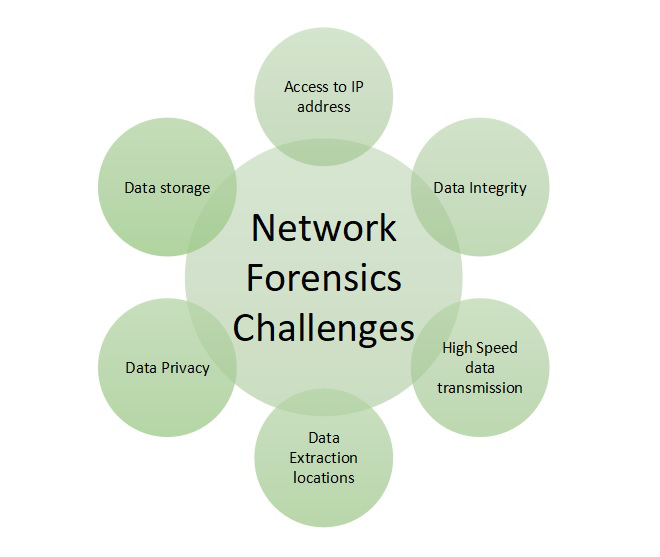
Challenges in Network Forensics:  

  • The biggest challenge is to manage the data generated during the process.
  • Intrinsic anonymity of the IP.
  • Address Spoofing

Challenges in Network Forensics

Advantages:

  • Network forensics helps in identifying security threats and vulnerabilities.
  • It analyzes and monitors network performance demands.
  • Network forensics helps in reducing downtime.
  • Network resources can be used in a better way by reporting and better planning.
  • It helps in a detailed network search for any trace of evidence left on the network.

Disadvantage:

  • The only disadvantage of network forensics is that it is difficult to implement.

Comments ()


Sign in

Read Next

Exploring Virtual Machines and Computer Forensic Validation Tools

Blog banner

INDIAN CHEAPEST COSMETICS BRAND

Blog banner

A Happier Workplace Starts with Healthy Lunches by Meal Maharaj

Blog banner

Rapido

Blog banner

What is Email? Uses of Emails

Blog banner

Memory input output management

Blog banner

Evolution of operating system

Blog banner

Evolution of the Microprocessor ~ Aditya Pai

Blog banner

Texting is actually better than talking in person

Blog banner

LEMON PICKLE (NIMBU KA ACHAR)

Blog banner

What do you mean by online marketing and why do you need to know about it

Blog banner

Music helps reduce stress

Blog banner

MEMORY MANAGEMENT REQUIREMENT

Blog banner

Mail merge

Blog banner

DISK SCHEDULING

Blog banner

Types of threads

Blog banner

Threads

Blog banner

Concurrency and memory

Blog banner

Memory Management

Blog banner

Linux -V Server Virtual Machine

Blog banner

My Favorite Sportsperson

Blog banner

Memory heirachy (Operating system)

Blog banner

The Bold Digital Marketing Moves That Made Durex India’s Second-Largest Condom Brand

Blog banner

Caching windows

Blog banner

Explain Kernel in OS

Blog banner

What is OS Fingerprinting?

Blog banner

Evolution of operating systems

Blog banner

Process State

Blog banner

How the mobile IP is used in GSM architecture.

Blog banner

Current Trends in GIS and Remote Sensing(Ocean Applications)

Blog banner

K-means use cases

Blog banner

Article on team management software

Blog banner

VIRTUAL MACHINES

Blog banner

Operating System Objectives and Functions

Blog banner

Delhi city

Blog banner

MODERN OPERATING SYSTEM

Blog banner

Elements and Principles of Photography

Blog banner

Random Forests

Blog banner

From Procrastinator to Performer: How to Beat the Last-Minute Rush

Blog banner

How to lose belly fat

Blog banner

Layers Of Blockchain

Blog banner

Philadelphia Experiment : Was it real?

Blog banner