wisemonkeys logo
FeedNotificationProfileManage Forms
FeedNotificationSearchSign in
wisemonkeys logo

Blogs

RSA (Rivest-Shamir-Adelman) Algorithm

profile
Jermin Shaikh
Apr 27, 2023
0 Likes
0 Discussions
134 Reads

When using RSA for encryption and decryption of general data, it reverses the key set usage. Unlike signature verification, it uses the receiver’s public key to encrypt the data, and it uses the receiver’s private key in decrypting the data. Thus, there is no need to exchange any keys in this scenario.


There are two broad components when it comes to RSA cryptography, they are: 

  • Key Generation: Generating the keys to be used for encrypting and decrypting the data to be exchanged.
  • Encryption/Decryption Function: The steps that need to be run when scrambling and recovering the data.


You need to generate public and private keys before running the functions to generate your ciphertext and plaintext. They use certain variables and parameters, all of which are explained below:

  • Choose two large prime numbers (p and q)
  • Calculate n = p*q and z = (p-1)(q-1)
  • Choose a number e where 1 < e < z
  • Calculate d = e-1mod(p-1)(q-1)
  • You can bundle private key pair as (n,d)
  • You can bundle public key pair as (n,e)
adv-RSA_Algorithm.

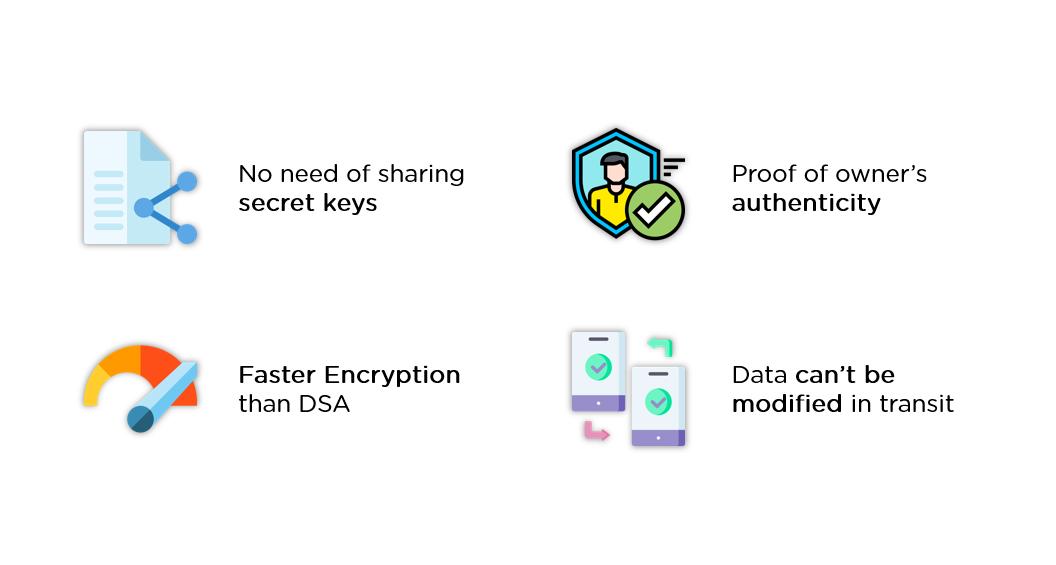
  • No Key Sharing: RSA encryption depends on using the receiver’s public key, so you don’t have to share any secret key to receive messages from others.
  • Proof of Authenticity: Since the key pairs are related to each other, a receiver can’t intercept the message since they won’t have the correct private key to decrypt the information.
  • Faster Encryption: The encryption process is faster than that of the DSA algorithm.
  • Data Can’t Be Modified: Data will be tamper-proof in transit since meddling with the data will alter the usage of the keys. And the private key won’t be able to decrypt the information, hence alerting the receiver of manipulation.

Comments ()


Sign in

Read Next

Threads and concurrency

Blog banner

Stories Woven in Silk: The Meaning Behind Patola Motifs

Blog banner

Product Discount Calculator

Blog banner

Memory management

Blog banner

Electronic Evidence in Cyber Forensics

Blog banner

Exploring Human Factors in Cyber Forensics Investigations.

Blog banner

GIS in Disaster Management

Blog banner

AI and cyber Security

Blog banner

Rain

Blog banner

Evolution of operating systems

Blog banner

OS PROCESS DESCRIPTION AND CONTROL-SARVAGYA JALAN

Blog banner

Rules and Regulations of Networking: "Standards and Protocols" - Part 1

Blog banner

Cyber Laws In India and Around the World

Blog banner

Busted : Common Web Security Myths

Blog banner

Threats To Computer System

Blog banner

Fitness

Blog banner

Outlook.com

Blog banner

15 Interesting Facts about India

Blog banner

What is Vishing?

Blog banner

bulk email software

Blog banner

Education?

Blog banner

Kernel Memory Allocation In Linux.

Blog banner

What is Segmentation?

Blog banner

Zero-Day Attack

Blog banner

child Labour

Blog banner

Understanding Regression Analysis

Blog banner

Understanding Input Based Keylogger Activation Systems: Risks and Mitigation

Blog banner

Penetration Testing

Blog banner

How to insert contacts in zoho crm using php

Blog banner

Uniprocessor scheduling

Blog banner

Data Warehousing

Blog banner

What are the different types of E-mail crime and process of email forensic?

Blog banner

Session Hijacking

Blog banner

SMARTSHEET MANAGEMENT SOFTWARE

Blog banner

PROCESS CONTROL BLOCK IN OS

Blog banner

Different Types of Data

Blog banner

Direct Memory Access

Blog banner

Top 5 Benefits of Artificial Intelligence

Blog banner

Virtual memory in os

Blog banner

Culture Of Ladakh

Blog banner

Smartsheet

Blog banner

'C', 'C++' and 'Java': Head-to-Head

Blog banner