wisemonkeys logo
FeedNotificationProfileManage Forms
FeedNotificationSearchSign in
wisemonkeys logo

Blogs

Evolution of the Microprocesor

profile
Ritam Paul
Jul 12, 2023
0 Likes
0 Discussions
133 Reads

Evolution of the microprocessor
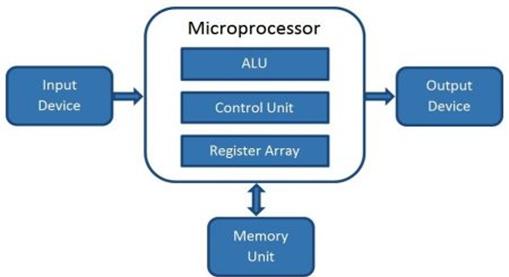
Computer's Central Processing Unit (CPU) built on a single Integrated Circuit (IC) is called a microprocessor The microprocessor contains millions of tiny components like transistors, registers, and diodes that work together. A microprocessor consists of an ALU, control unit and register array .


Evolution of Microprocessors :- 
We can categorize the microprocessor according to the generations or according to the size of the microprocessor: 


1) First Generation (4 - bit Microprocessors):- The first generation microprocessors were introduced in the year 1971-1972 by Intel Corporation. It was named Intel 4004 since it was a 4-bit processor.
It was a processor on a single chip. It could perform simple arithmetic and logical operations such as addition, subtraction, Boolean OR and Boolean AND.

2) Second Generation (8 - bit Microprocessor) :- The second generation microprocessors were introduced in 1973 again by Intel. It was a first 8 - bit microprocessor which could perform arithmetic and logic operations on 8-bit words. It was Intel 8008, and another improved version was Intel 8088.

3) Third Generation (16 - bit Microprocessor) :- The third generation microprocessors, introduced in 1978 were represented by Intel's 8086, Zilog Z800 and 80286, which were 16 - bit processors with a performance like minicomputers.

4) Fourth Generation (32 - bit Microprocessors) :- Several different companies introduced the 32-bit microprocessors, but the most popular one is the Intel 80386.

5) Fifth Generation (64 - bit Microprocessors):- From 1995 to now we are in the fifth generation. After 80856, Intel came out with a new processor namely Pentium processor followed by Pentium Pro CPU, which allows multiple CPUs in a single system to achieve multiprocessing.


Comments ()


Sign in

Read Next

Memory management

Blog banner

Explain Multiprocessors

Blog banner

Service Design Model

Blog banner

Mesh Topology

Blog banner

OS assignment 3

Blog banner

Emerging threats in cyber Forensics

Blog banner

What are Tenders its various types

Blog banner

Explain the concept of ( MIS) Management information systems

Blog banner

Uniprocessor Scheduling

Blog banner

Clustering Techniques

Blog banner

Outlook.com

Blog banner

Study on cyber and network forensic in computer security management

Blog banner

RSA (Rivest-Shamir-Adelman) Algorithm

Blog banner

Deadlocks in Operating Systems

Blog banner

Virtual Memory - Explaination, Working, Steps

Blog banner

Synchronization

Blog banner

Objectives and Functions of Operating System

Blog banner

Development Of Modern Operating System

Blog banner

What is M-commerce and how it's work

Blog banner

Unlocking Success: Mastering Google Ads Strategies

Blog banner

Article on different management system

Blog banner

The Evolution of the Microprocessor ~ Aditya Pai

Blog banner

Cyber Forensics in Healthcare: Protecting Patient Data and Preventing Breaches

Blog banner

GIS

Blog banner

What is OS and its overview

Blog banner

Dangers of Using Public WiFis

Blog banner

CYBERPEACEKEEPING: NEW WAYS TO PREVENT AND MANAGE CYBERATTACKS

Blog banner

All you need to know about “On-page SEO”

Blog banner

(Input/Output) in os

Blog banner

Kernel in Operating System

Blog banner

Interrupts

Blog banner

Yahoo! mail

Blog banner

10 Reasons to date your best friend

Blog banner

The Essential Guide to Dynamic Arrays vs. Linked Lists: Which to Use and When ?

Blog banner

Service Strategy In ITSM

Blog banner

10 Alien Encounters and Abduction Stories

Blog banner

Fitness

Blog banner

Balance

Blog banner

Linux 94

Blog banner

differentiate thinking humanly and rationally

Blog banner

Amazon

Blog banner

Measuring IT Risk

Blog banner