wisemonkeys logo
FeedNotificationProfileManage Forms
FeedNotificationSearchSign in
wisemonkeys logo

Blogs

Multicore CPUs

profile
Neeti undefined
Jul 04, 2024
0 Likes
0 Discussions
72 Reads

MULTICORE CPUs

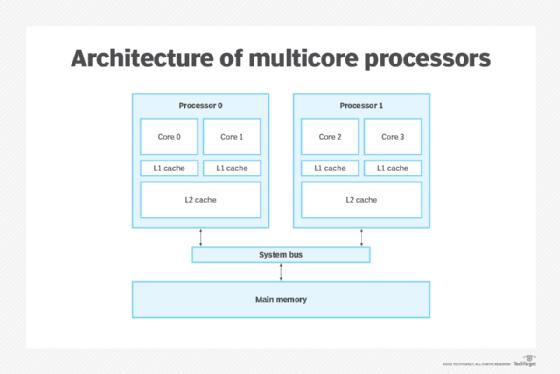
Usually before multicore os was discovered ek hi cpu use to perform all the operations such cpu was called uni core processor. Jiske wajah se multiple processing (bahut saare computer programs ek sath perform karna) was not possible. A cpu consist of ALU (that performs all the arithmetic operations), Control unit (cpu ke activities ko control karta hai), registers (yaha pe data temporarily store hota hai). Multicore cpus have more than one set of ALU, CU and Registers which helps in more efficient and faster processing of data. When computer receives data to process data divide ho jata hai between the Cpus jiske wajah se result faster milta hai. Jab processed data chips se nikalta hai woh result ese hi aata hai as if its from a single chip. Now most of the systems have 4 core (quad core) or eight cores (octa core). This helps to increase processing speed and the helps to reduce the heat generated by computer. Multicore systems support multithreading and parallel computing. Multithreading is a process where multiple threads are executed ek hi time pe. Threads means small task that os needs to do threads allow the program to do small tasks ek sath at one time for eg- jab we use web browser ek thread will be responsible for loading, one will be responsible for scrolling, one might be responsible for playing a video. Yeh saare threads work independently (hence result in faster execution) but share same memory. Parallel computing means jab ek problem ko computer small small tasks mai divide karta hai fir end mai result of combine kar deta hai. Parallel computing se complex tasks easily and quickly ho jate hai. Parallel computing mai multiple processors use hote hai joh different tasks ko handle karte hai ek sath. Tho basically multicore processor help the computer to work more efficiently and process tasks quicker.

Neeti Joshi



Comments ()


Sign in

Read Next

The Laws of Karma

Blog banner

E-Cash (Electronic Cash)

Blog banner

Deadlocks in Operating Systems

Blog banner

Different Types of Data

Blog banner

Proof-of-Stake (PoS)

Blog banner

Digital Balance: Keeping Children Mindful in the Screen Age

Blog banner

Getting to Kashmir: Alternative to the Jammu-Srinagar highway

Blog banner

My favourite food

Blog banner

Simple AI Symptom Diagnosis Using LISP – Rule-Based Expert System

Blog banner

Tea, Coffee, Red Wine, and Teeth: A Stain Survival Guide

Blog banner

MOBILE DEVICE FORENSIC

Blog banner

MPL and how its effects?

Blog banner

Topic: Sessions in Operating system

Blog banner

Security issues

Blog banner

The evolution of OS

Blog banner

What is Amazon?

Blog banner

CYBERPEACEKEEPING: NEW WAYS TO PREVENT AND MANAGE CYBERATTACKS

Blog banner

Compromising Mobile Platforms

Blog banner

S-Tool : Steganography

Blog banner

21ST CENTURY PATRIARCHY

Blog banner

Question

Blog banner

Protect yourself from System Hacking with these Simple Steps

Blog banner

Threads and concurrency

Blog banner

How Puppet Shows and Role Play Teach Empathy to Preschoolers

Blog banner

Blockchain

Blog banner

Mumbai local ......

Blog banner

Understanding Univariate, Bivariate, and Multivariate Analysis in Data Science

Blog banner

What do you mean by online marketing and why do you need to know about it

Blog banner

Cache Memory

Blog banner

All you need to know about “On-page SEO”

Blog banner

India Digital Personal Data Protection Act, 2023

Blog banner

Social media

Blog banner

Data Visualization- Importance and tools (Tableau,Power BI, Matplotlib)

Blog banner

Cyber Forensics

Blog banner

Linux Virtual Machine Process Scheduling

Blog banner

MAJOR ACHIEVEMENTS OF OS

Blog banner

Process Creation

Blog banner

GIS in Disaster Management

Blog banner

Memory Management

Blog banner

Deadlock in operating system

Blog banner

Linux

Blog banner

memory cache

Blog banner