wisemonkeys logo
FeedNotificationProfileManage Forms
FeedNotificationSearchSign in
wisemonkeys logo

Blogs

RAID and It's Levels

profile
VL Patel
Sep 12, 2024
0 Likes
0 Discussions
159 Reads
Let's understand the RAID first, RAID (Redundant Array of Independent Disks) is like having backup copies of your important files stored in different places on several hard drives or solid-state drives (SSDs). If one drive stops working, your data is still safe because you have other copies stored on the other drives. It’s like having a safety net to protect your files from being lost if one of your drives breaks down.
Now let's understand RAID with view of Database, RAID in a Database Management System (DBMS) is a technology that combines multiple physical disk drives into a single logical unit for data storage. The main purpose of RAID is to improve data reliability, availability, and performance. 
Some Keys Points of RAID to understand:-
1.Reliability: How many disk faults can the system tolerate? 
2.Availability: What fraction of the total session time is a system in uptime mode, i.e. how available is the system for actual use? 
3.Performance: How good is the response time? How high is the throughput (rate of processing work)? Note that performance contains a lot of parameters, not just the two. 
4.Capacity: Given a set of N disks each with B blocks, how much useful capacity is available to the user? 

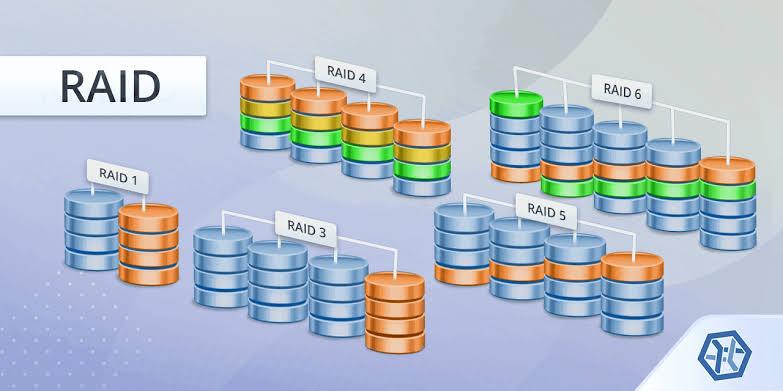
There are Different RAID Levels that are as follows:-
RAID-0 (Stripping) 
RAID-1 (Mirroring) 
RAID-2 (Bit-Level Stripping with Dedicated Parity)
RAID-3 (Byte-Level Stripping with Dedicated Parity)
RAID-4 (Block-Level Stripping with Dedicated Parity) 
RAID-5 (Block-Level Stripping with Distributed Parity) 
RAID-6 (Block-Level Stripping with two Parity Bits).

Some Advantages of RAID are:-
1.Data Redundancy 
2.Scalability
3.Performance Enhancement.

Some Disadvantages of RAID are:-
1.Cost Factor is more
2.Complexity in terms of setup.
3.Decreased Performance in parity calculations in terms of RAID-5 and RAID-6.

Comments ()


Sign in

Read Next

MySQL

Blog banner

Deadlock in operating system

Blog banner

Electronic Evidence in Cyber Forensics

Blog banner

Pipedrive

Blog banner

OPERATING SYSTEM

Blog banner

How to use open SSL for web server - browser communication

Blog banner

Importance of Website

Blog banner

Pilgrimage at LOC: A privilege and a paradox

Blog banner

Junk food vs healthy food

Blog banner

ahh wait a min

Blog banner

Fashion design

Blog banner

Operating System

Blog banner

10 Signs your Computer has Virus

Blog banner

The Right way of cooking

Blog banner

Types of Malware in Cyber Security

Blog banner

Explain Kernel in OS

Blog banner

Classification Algorithms (Decision trees, SVM, Logistic regreession)

Blog banner

All you need to know about “Off-page SEO”

Blog banner

Operating System

Blog banner

Difference Between Classification And Clustering

Blog banner

LTE Technology

Blog banner

Evolution of Operating Systems

Blog banner

DBMS and various career options related to it.

Blog banner

BrainGate Technology

Blog banner

Direct Memory Access

Blog banner

Craziness of dream 11 and how it impacts on our life

Blog banner

Exploring the Power of Encase Forensic Tools: Unraveling Digital Mysteries

Blog banner

Jira Software

Blog banner

Assignment 2

Blog banner

VIRTUAL MEMORY

Blog banner

Inventory management software system

Blog banner

Modern Operating system

Blog banner

Instagram

Blog banner

Art and Culture of Rajasthan

Blog banner

Session Hijacking Techniques

Blog banner

Volatile Memory & Non-Volatile Memory Explained

Blog banner

SECURITY RISKS OF REMOTE WORKING

Blog banner

Introduction my self

Blog banner

Bharat Maps

Blog banner

Photorec - media recovery tool

Blog banner

Vikrant’s first blog

Blog banner

Segmentation and paging concept

Blog banner