wisemonkeys logo
FeedNotificationProfileManage Forms
FeedNotificationSearchSign in
wisemonkeys logo

Blogs

DISK SCHEDULING

profile
vivek pandey
Sep 09, 2024
0 Likes
0 Discussions
38 Reads

DISK SCHEDULING

  • Disk scheduling is a technique operating systems use to manage the order in which disk I/O (input/output) requests are processed. Disk scheduling is also known as I/O Scheduling. The main goals of disk scheduling are to optimize the performance of disk operations, reduce the time it takes to access data and improve overall system efficiency.
  • In this article, we will explore the different types of disk scheduling algorithms and their functions. By understanding and implementing these algorithms, we can optimize system performance and ensure faster data retrieval.

Importance of Disk Scheduling in Operating System:

  • Multiple I/O requests may arrive by different processes and only one I/O request can be served at a time by the disk controller. Thus other I/O requests need to wait in the waiting queue and need to be scheduled.
  • Two or more requests may be far from each other so this can result in greater disk arm movement.
  • Hard drives are one of the slowest parts of the computer system and thus need to be accessed in an efficient manner.

Key Terms Associated with Disk Scheduling

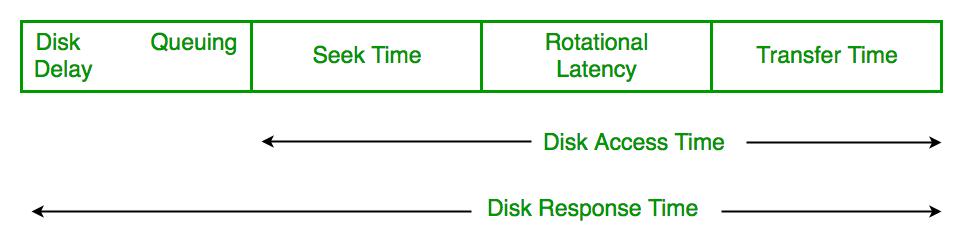
  • Seek Time: Seek time is the time taken to locate the disk arm to a specified track where the data is to be read or written. So the disk scheduling algorithm that gives a minimum average seek time is better.
  • Rotational Latency: Rotational Latency is the time taken by the desired sector of the disk to rotate into a position so that it can access the read/write heads. So the disk scheduling algorithm that gives minimum rotational latency is better.
  • Transfer Time: Transfer time is the time to transfer the data. It depends on the rotating speed of the disk and the number of bytes to be transferred.

  • Disk Access Time:


Comments ()


Sign in

Read Next

Animal’s have my heart

Blog banner

Understanding Regression Analysis

Blog banner

PODIO

Blog banner

Deadlock and Starvation

Blog banner

rupee

Blog banner

Deadlock

Blog banner

Multiprocessor

Blog banner

The Importance of Financial Literacy for College Students

Blog banner

Emerging threats in cyber Forensics

Blog banner

QUANTUM COMPUTING IN SECURITY:A GAME CHANGER IN DIGITAL WORLD

Blog banner

Phishing

Blog banner

SQL Injection

Blog banner

Evolution of operating systems

Blog banner

Deadlocks

Blog banner

Penetration Testing

Blog banner

Study of Backdoor and Trojan tools

Blog banner

Paralysis/Paralysis Stroke

Blog banner

Digital black market or dark net poses a national security threat?

Blog banner

This too shall pass

Blog banner

Why Data Security Is Important

Blog banner

VIRTUAL MACHINE

Blog banner

CYBER SECURITY CHALLENGES

Blog banner

The Rise of Evil Twin Attacks: A New Kind Of Spoofing Cyberattack

Blog banner

Guidelines for a low sodium diet.

Blog banner

INTERNET SECURITY

Blog banner

Direct Memory Access

Blog banner

Modern Operating Systems.

Blog banner

DNS Cache

Blog banner

Threat from Inside: Educating the Employees Against Cyber Threats

Blog banner

Types Of scheduling

Blog banner

Predictive Analysis - Ek Overview

Blog banner

What is Vishing?

Blog banner

Memory Management in Operating System

Blog banner

Virtual Memory

Blog banner

Method of Evaluating Information Security Level in an Organization

Blog banner

Benefits and drawback of web security.

Blog banner

POSITIVE ATTITUDE IN LIFE

Blog banner

Os(Computer security threats)

Blog banner

Deadlock in Operating System

Blog banner

Business-to-Business

Blog banner

MEMORY MANAGEMENT (techniques)

Blog banner

'C', 'C++' and 'Java': Head-to-Head

Blog banner